Mold grows wherever moisture and organic material meet for long enough. In Fairfax County's climate — humid summers, periodic basement flooding from clay soil and sump failures, and older housing stock with inadequate ventilation in bathrooms and crawlspaces — the conditions that produce mold are common. The mold itself is not the primary problem; it is evidence of an unresolved moisture condition. Removing the visible mold without addressing the moisture source means the mold returns.
Call (703) 397-8315 for mold remediation in Fairfax, VA — 24/7.
Identifying the Moisture Source First
Every mold remediation scope begins with identifying why the mold is there. The moisture source — a leaking supply line, inadequate bathroom ventilation, groundwater seepage through a foundation wall, a roof leak saturating attic insulation, a condensate drain line clogged in summer — must be identified and corrected before remediation begins, or the scope will need to be repeated. We do not start removing mold until the moisture source is confirmed and either corrected or scheduled for correction concurrent with the remediation scope.
| Mold Location | Typical Moisture Source | Remediation Approach | Fairfax Prevalence |
|---|---|---|---|
| Basement walls / floor | Groundwater seepage, sump failure, flooding | Demo affected drywall; treat framing; dry; encapsulate if needed | High — clay soil + older basement walls throughout county |
| Bathroom (tile grout, drywall) | Inadequate ventilation, shower pan failure | Surface treatment if non-porous; demo if drywall affected | High — 1970s–1980s bathrooms without exhaust fans |
| Attic (roof deck, framing) | Inadequate ventilation, roof leak, ice dam | HEPA vacuuming, antimicrobial treatment, ventilation correction | Moderate — older homes with inadequate soffit/ridge venting |
| Crawlspace | Groundwater, vapor transmission, HVAC condensate | Treat joists and sheathing; vapor barrier; ventilation | Moderate — homes with unencapsulated crawlspace |
| HVAC system | Drain pan overflow, coil condensation, duct condensation | Coil and duct cleaning; drain correction; air handler treatment | High in summer — Fairfax humidity drives condensation |
| Wall cavity (post-water damage) | Unaddressed water intrusion, pipe leak, flooding | Open cavity, remove contaminated insulation and drywall; treat framing | High after any water event that was delayed in remediation |
IICRC S520 Remediation Standards
We follow IICRC S520 standards for mold remediation, which define containment requirements, personal protective equipment, removal protocols for different materials, and post-remediation verification requirements. These standards exist because improperly handled mold remediation — disturbing mold growth without containment, using bleach on porous surfaces, or failing to remove contaminated materials — distributes spores throughout the building and converts a localized problem into a whole-home air quality concern.
S520 standards distinguish between different mold contamination levels and prescribe different approaches: surface treatment for non-porous materials with minor growth, full material removal for porous materials with any mold growth, and whole-building HVAC assessment when growth is found in or near the air distribution system.
Containment During Remediation
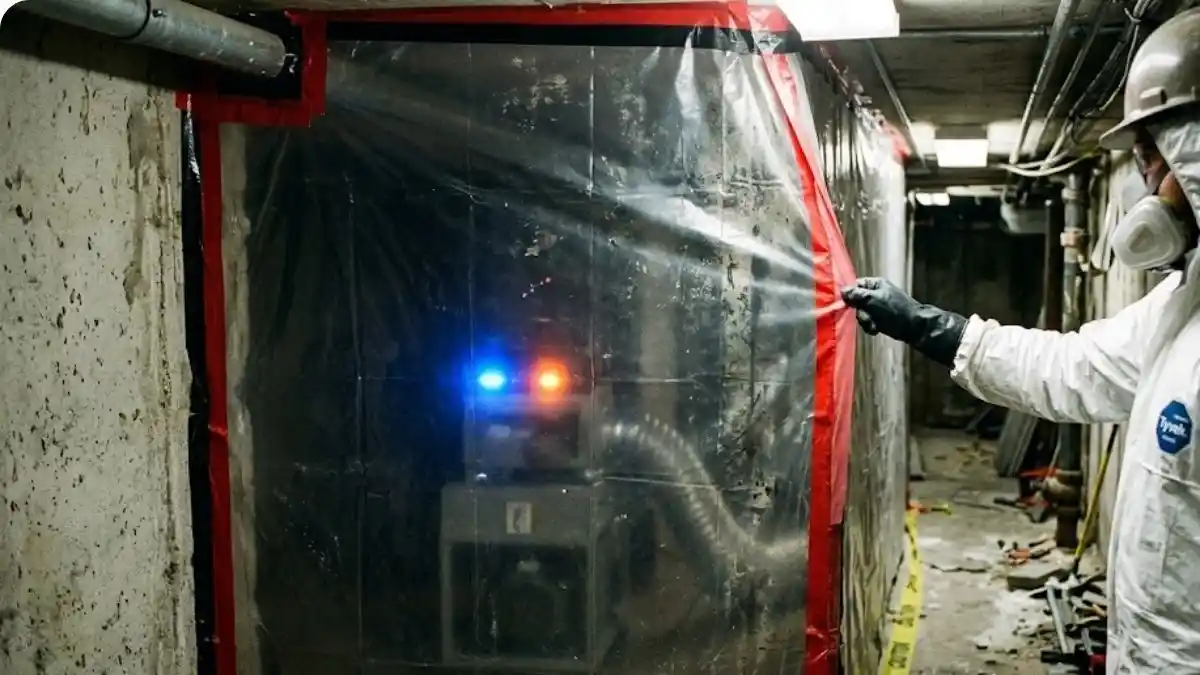
Before any mold-affected materials are disturbed, the work area is contained using poly sheeting sealed to adjacent surfaces with tape. Negative air pressure is established inside the containment zone using an air scrubber equipped with HEPA filtration that exhausts to the exterior — this prevents spores disturbed during remediation from migrating to unaffected areas. All personnel inside the containment zone wear appropriate PPE including N-95 or higher respirators, nitrile gloves, and protective coveralls.
Containment is not removed until all affected materials have been removed, remaining surfaces have been cleaned and treated with an EPA-registered antimicrobial agent, and post-remediation visual inspection confirms no visible mold remains.
Material Removal: What Must Come Out
Mold growth on porous materials — drywall, insulation, carpet, and wood that has been colonized through the surface — cannot be remediated by cleaning alone. The mold mycelium penetrates into the material and cannot be fully removed without removing the material itself. Drywall with mold growth is cut out and removed; insulation is always removed if it has been in contact with mold or the moisture that caused the mold; carpet and pad are removed. Wood framing that has surface mold growth can often be remediated in place through HEPA vacuuming, sanding, and antimicrobial treatment if the structural integrity is not compromised. Wood with deep mold penetration into the grain may require replacement.
Black Mold, Hidden Mold, and HVAC Mold
Stachybotrys chartarum — the species commonly called black mold — requires sustained high moisture levels to grow and is most commonly found in chronically wet wall cavities, under flooring over water-damaged subfloor, and in ceiling materials with long-term roof intrusion. It is one specific species among many that require remediation; any mold growth in a building at elevated concentrations represents a condition that needs professional attention regardless of the species.
Hidden mold inside wall cavities is identified through moisture meter readings at wall surfaces, musty odor present without visible growth, and targeted inspection access. HVAC mold — growth on coil surfaces, in drain pans, or inside ductwork — is a particular concern in Fairfax County because the HVAC system distributes mold spores to every room it serves. HVAC mold remediation includes disinfecting the coil and drain pan assembly, cleaning accessible duct surfaces, and correcting the condensate drain issue that caused the growth.
Musty Odor After Water Damage
A musty smell in a basement, crawlspace, or bathroom that appears after a water event is a strong indicator of mold growth, often in a location that is not immediately visible: inside a wall cavity, behind a baseboard, under flooring, or in the ceiling assembly above. We use moisture meters and visual inspection to locate the moisture source associated with the odor before opening walls or floors unnecessarily. If mold is present, the odor source is the mold colony itself, and odor elimination requires removing the colony — not deodorizing the air above it.
See our mold inspection and testing page for air and surface sampling that can confirm mold presence and species identification before remediation begins.