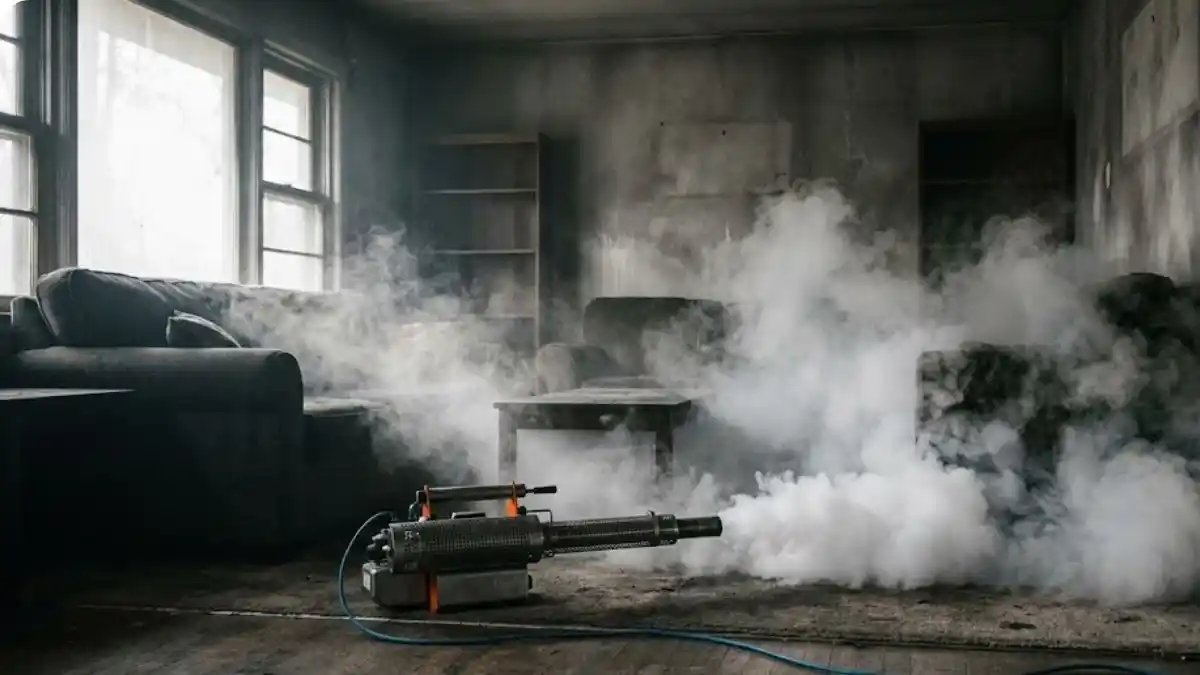
Smoke smell that returns after cleaning is the most common complaint after a fire restoration job that was done incompletely. The reason is straightforward: smoke odor compounds do not stay on surfaces. During a fire, volatile organic compounds penetrate into porous materials — drywall, wood framing, carpet pad, insulation, upholstered furniture — and remain there after the fire is out and surface soot has been removed. Surface cleaning addresses the visible layer but leaves the embedded source material intact. The odor continues to off-gas from these materials for months.
Call (703) 397-8315 for professional smoke odor removal in Fairfax, VA.
Why Smoke Smell Persists After Surface Cleaning
The embedded odor problem is a physics problem. Smoke molecules are small enough to penetrate porous surfaces during a fire when they are airborne at elevated temperatures. Once inside the material, they bind to organic compounds in wood fibers, drywall paper, and fabric. Wiping the surface removes the external soot layer but has no effect on the molecules inside the material. Over time — particularly during warm or humid weather, which is common in Fairfax summers — those embedded compounds off-gas back through the surface and the odor returns.
The only reliable solution is a treatment that reaches inside the porous material to neutralize the odor compounds at their location. That is what thermal fogging, ozone treatment, and hydroxyl generators accomplish.
Thermal Fogging for Embedded Smoke Odor
Thermal fogging produces a deodorizing aerosol that behaves like smoke: it penetrates into the same porous materials that smoke infiltrated during the fire. The aerosol particles are small enough to enter wall cavities, reach inside insulation batts, penetrate carpet pad fibers, and travel into structural framing members. Once there, the deodorizing agent chemically reacts with odor compounds and neutralizes them — it does not mask the odor, it eliminates the molecular source.
Thermal fogging requires complete vacating of the property, including pets, plants, and food items. Ventilation after treatment clears the fog, and the space is safe for re-occupancy once the deodorizing aerosol has dissipated and the odor has been confirmed absent. We do not declare odor elimination complete until you — not our crew — confirm the smell is gone.
Ozone Treatment and Hydroxyl Generators
Ozone generators produce ozone gas (O³), which oxidizes odor compounds and destroys them chemically. At the concentrations required for effective odor treatment, ozone is harmful to people, pets, and plants, requiring complete unoccupied operation. The property is sealed during treatment, then thoroughly ventilated. Ozone is highly effective for heavy smoke odor situations where thermal fogging alone is insufficient.
Hydroxyl generators produce hydroxyl radicals through ultraviolet light exposure. Hydroxyl radicals are powerful oxidizers that neutralize odor compounds in the air and on surfaces. Unlike ozone, hydroxyls are safe at the concentrations used in restoration settings, making hydroxyl generators suitable for situations where some occupancy during treatment is required, or where pets or plants cannot be removed. We often use thermal fogging and hydroxyl treatment in sequence on heavy odor cases.
| Treatment Method | How It Works | Occupancy During | Best For |
|---|---|---|---|
| Thermal Fogging | Deodorizing aerosol penetrates porous surfaces | Must vacate | Embedded odor in walls, framing, insulation, carpet pad |
| Ozone Treatment | O³ oxidizes and destroys odor compounds | Must vacate (people, pets, plants) | Heavy odor, sealed spaces, severe contamination |
| Hydroxyl Generator | UV-generated radicals neutralize airborne and surface compounds | Generally safe for occupancy | Active spaces, pets or plants present, ongoing treatment |
HVAC Ducts as Odor Sources
The HVAC system is almost always an odor source after a fire, even when surface cleaning appears complete. Soot deposits inside ductwork continue to release odor compounds each time the system operates. Running the system post-cleanup without duct cleaning redistributes odor throughout every room every cycle. HVAC cleaning is a required step in our smoke odor removal scope, not an optional upgrade.
We inspect and clean all accessible duct runs, the air handler cabinet, coil surfaces, and the blower assembly. Where odor compounds have penetrated beyond the duct surface into insulated flex duct, replacement may be necessary to achieve full odor elimination.
Nicotine and Tobacco Smoke Odor Removal
Nicotine and tobacco smoke odor is chemically similar to fire smoke odor in its behavior: volatile compounds penetrate porous surfaces and off-gas over time, while a yellowed residue film coats painted and non-porous surfaces. The cleanup approach parallels fire smoke restoration: thorough surface cleaning to remove the nicotine film, followed by thermal fogging or ozone treatment to neutralize embedded compounds.
Heavily nicotine-affected walls and ceilings typically require an encapsulating primer coat that seals residue into the substrate before repainting. Without this step, odor compounds and yellowing bleed through new paint layers within months. We document which surfaces require encapsulation as part of our scope assessment.
Air Quality Verification Before Re-Occupancy
We do not declare smoke odor removal complete based on our crew's evaluation. Before re-occupancy, you confirm that the odor is absent. If any odor remains, we treat again. For commercial properties or cases involving elevated air quality concern, third-party air sampling can be arranged as part of the clearance process. This documentation is also available to your insurance carrier as evidence of completed remediation.