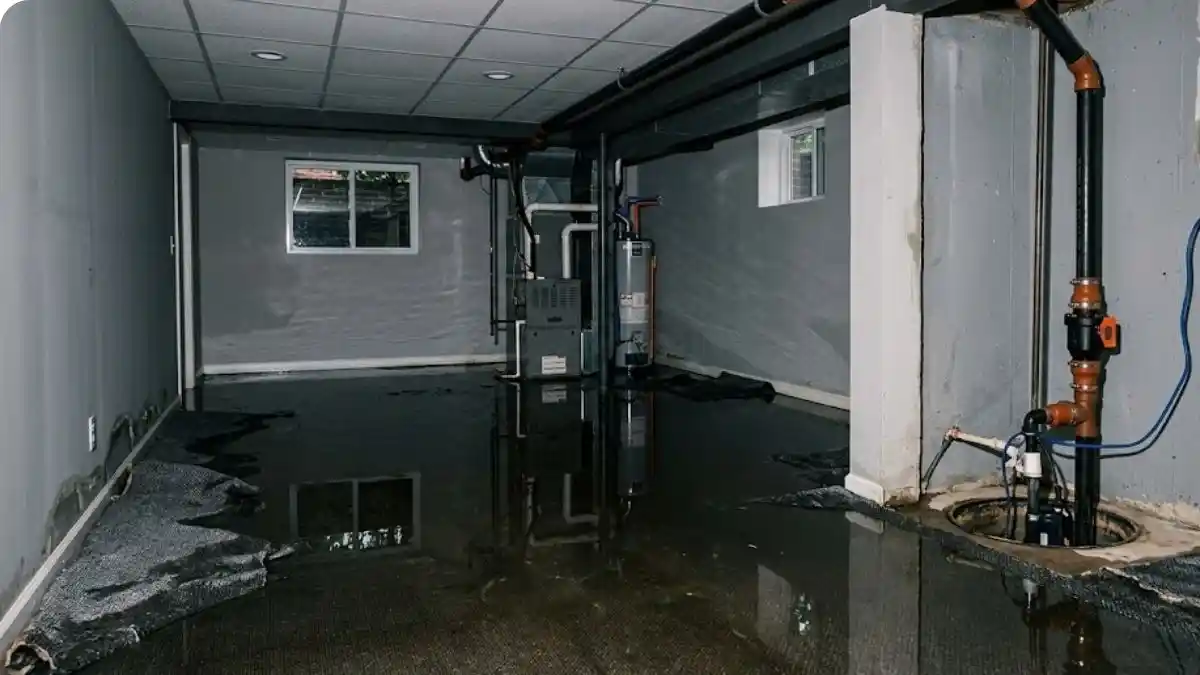
Fairfax County's clay-heavy soil does not drain water away from foundations — it holds it there. During a heavy rain event, saturated clay soil builds hydrostatic pressure against basement walls and floor slabs. Cracks that were dry all season suddenly weep. Window well drains back up. Sump pits fill faster than pumps can discharge. When the pump loses power at 3 AM during a summer thunderstorm, a finished basement fills in hours.
Call (703) 397-8315 for flooded basement cleanup in Fairfax, VA — 24/7.
Common Causes of Basement Flooding in Fairfax County
Sump pump failure is the leading cause of basement flooding calls across Fairfax County — particularly in lower-lying areas of Burke, West Springfield, North Springfield, and the Route 50 corridor through Annandale. These neighborhoods were built during the 1960s and 1970s when drainage engineering and sump system design were less sophisticated than modern standards. Battery backup systems help when power fails, but when a sump is simply overwhelmed by volume, backup capacity is finite.
Groundwater seepage through foundation walls is the secondary pattern, especially in homes along Braddock Road and the older residential corridors around Fairfax City. The clay soil layer that makes northern Virginia's landscape distinctive also channels water horizontally along the soil interface rather than letting it percolate down, directing it toward the lowest pressure point — a basement wall or floor joint.
| Flood Source | Coverage Type | Key Action | Fairfax Notes |
|---|---|---|---|
| Sump pump failure | Sump pump rider (if purchased) | Document pump failure before removing water | Most common basement call in Burke, Springfield, West Springfield |
| Groundwater / hydrostatic seepage | NFIP flood policy (typically) | Photograph water entry points | Clay soil along Route 50, Braddock Rd corridors |
| Window well overflow | May fall under NFIP or HO depending on source | Photograph window well condition | Common in below-grade entries on townhomes |
| Interior plumbing failure | Standard HO (sudden/accidental) | Shut off water supply first | Supply lines, hot water heater in utility area |
| Sewage backup into basement | Sewer backup rider | Do not enter without PPE | Older sewer laterals in Annandale, North Springfield |
Electrical Safety First
Before entering a flooded basement, confirm that the electrical panel is off and that no live outlets are submerged. Water and active electrical circuits in an enclosed space are a life-threatening combination. If you cannot safely confirm the panel is off without entering the water, do not enter — call us and your utility provider. We deploy portable submersible pumps from outside the water when electrical safety cannot be confirmed.
Extraction and the Importance of Sequence
High-volume extraction removes standing water, but the order of operations matters. Carpet and pad must be extracted and then removed — wet carpet pad holds water like a sponge and prevents subfloor drying regardless of how much drying equipment runs over it. Carpet is almost never salvageable after a basement flood; pad is never salvageable. Removing them reveals the subfloor condition and allows air movers to work on the structural surface directly.
After carpet removal, we extract residual water from the subfloor surface, then position air movers to create airflow across the subfloor and lower wall surfaces. LGR dehumidifiers pull moisture from the air as it evaporates off wet materials. Equipment runs continuously, 24 hours a day, until moisture meter readings at structural materials confirm dryness.
Finished Basements: Flood Cuts and Wall Cavity Drying
In a finished basement with drywall and insulation, water in the wall cavity cannot be dried from the surface. Fiberglass batt insulation absorbs and retains water for weeks when sealed inside a wall; the drywall surface may feel dry to the touch while the cavity behind it remains saturated. Mold colonizes this wet insulation within 24 to 48 hours.
A flood cut removes the lower 12 to 24 inches of drywall above the water line, exposes the framing and insulation, removes the wet insulation, and opens the cavity to direct airflow. This is not optional on a seriously flooded finished basement — it is the intervention that prevents a drying job from becoming a mold remediation project. We document the pre-demolition moisture readings and the post-flood-cut cavity condition for your insurance adjuster.
Crawlspace Water Removal
Crawlspace flooding presents different challenges than a basement event. Standing water in a crawlspace saturates the soil, raises humidity to near-100% inside the enclosed space, and wets floor joists, subfloor sheathing, and any mechanical systems running through the space. We extract standing water, deploy drying equipment in the crawlspace, and assess whether vapor barrier replacement is required after drying. Crawlspace mold resulting from unaddressed water intrusion is addressed through our mold remediation service.
After the Flood: Mold Prevention Timeline
Mold spores are present in ambient air in every building. When structural materials stay above the moisture threshold that supports growth for more than 24 to 48 hours — sooner in Fairfax County's humid summers — colonization begins on wet drywall paper, wood framing, and insulation. The intervention that prevents mold is getting drying equipment in place within the first hours after flooding, not days. If mold is already present, see our mold remediation page.