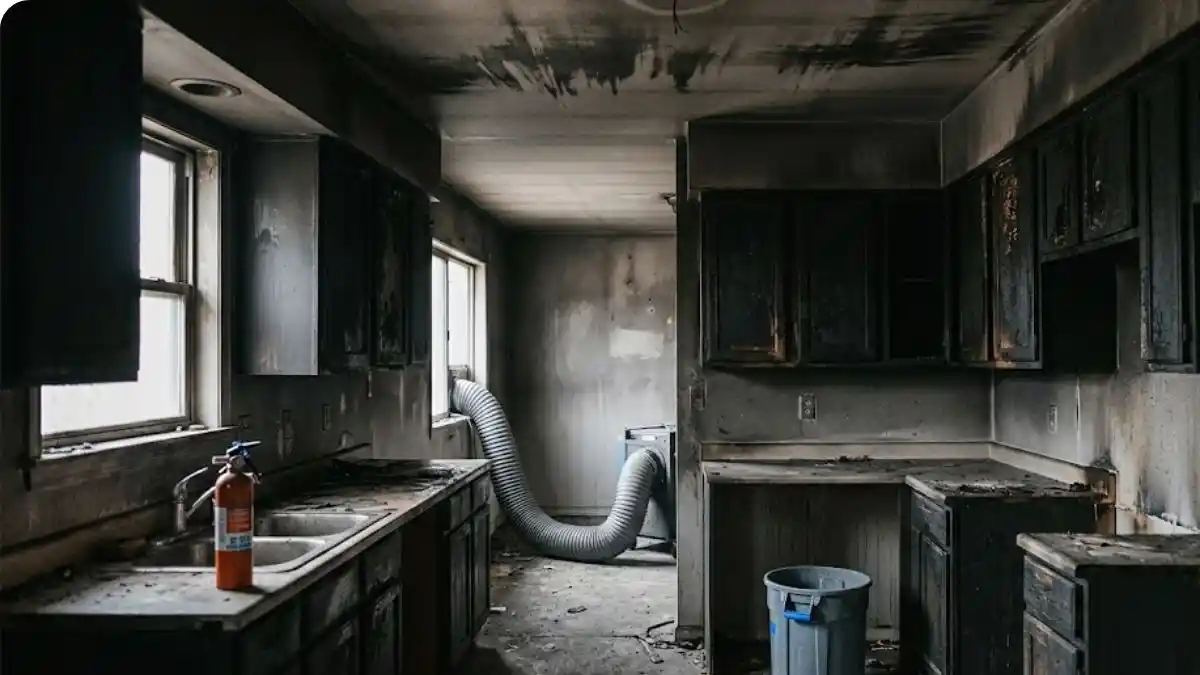
Fire damage is not one event — it is a sequence of overlapping problems that begin the moment flames appear and continue long after the fire trucks leave. Structural char, three distinct categories of smoke residue with different chemistry, firefighting water that creates its own drying challenge, and odor compounds embedded in porous materials that outlast every surface-cleaning attempt: all of these run simultaneously and must be addressed in a coordinated sequence, not in isolation.
Call (703) 397-8315 for fire damage restoration in Fairfax, VA — available 24 hours a day, 7 days a week.
Why Fire Type Determines the Restoration Approach
The chemistry of smoke residue changes based on what burned, how fast it burned, and how much oxygen was available. A kitchen grease fire that self-extinguishes in a skillet leaves nearly invisible protein smoke — a thin, pungent film that bonds so tightly to surfaces it can survive surface cleaning and re-appear as a persistent odor months later. A structure fire involving burning drywall and synthetic carpet releases oily, heavy soot that travels through ductwork and deposits on every surface in the HVAC system. A chimney fire generating creosote combustion creates dry soot that spreads widely but responds to different agents than the oily type.
Applying the wrong cleaning chemistry to any of these types does not just fail — it can set the stain permanently or drive residue deeper into porous materials. Our IICRC Fire and Smoke Restoration Technicians (FSRT) assess the residue type before any cleaning begins.
| Fire Type | Primary Residue | Key Challenge | Fairfax Context |
|---|---|---|---|
| Kitchen / Grease | Protein smoke (nearly invisible film) | Bonds tightly to all surfaces; strong persistent odor | Most common residential fire type in NoVA |
| Electrical / Wiring | Oily soot + acrid odor | Hidden damage inside walls; HVAC spread | Older Fairfax County wiring in 1960s–1980s homes |
| Chimney Fire | Dry soot + creosote | Attic spread; structural check required | Older chimneys in Oakton, Vienna, Old Town Fairfax |
| Structure / Multi-Room | All three residue types | HVAC distribution to every room | Townhome density means neighboring units affected |
| Neighbor’s Unit Fire | Secondary smoke infiltration | Source is outside your unit; insurance coordination | Common in Kingstowne, Centreville, Farrcroft condos |
Smoke and Soot Travel in Fairfax Homes
In a typical Fairfax County townhome or single-family home with forced-air heating, smoke-laden air is drawn into return vents within minutes of a fire. The HVAC system then acts as a distribution network, depositing soot and odor particles throughout every duct run and into every room the system serves. By the time the fire is out, the contamination may already extend to bedrooms, closets, and finished basement areas far from the fire's origin.
Older Fairfax neighborhoods — North Springfield, Annandale, Cobbdale, Old Lee Hills — often have original ductwork from the 1960s and 1970s that has accumulated decades of particulate. A fire event drives fresh soot into this existing layer, complicating air quality restoration. HVAC duct cleaning is a standard component of our fire restoration scope, not an optional add-on.
Firefighting Water Is Part of Every Fire Restoration
Every structure fire generates water damage from suppression. Fire departments use high-volume water flows that saturate walls, floors, and structural cavities far beyond the fire's perimeter. This water must be extracted and the structure dried to IICRC S500 standards before reconstruction begins — moisture left behind inside wall cavities creates mold conditions within 24 to 48 hours.
We run water extraction and structural drying in parallel with smoke and soot cleanup. The psychrometric data from our equipment — temperature, relative humidity, dew point, and moisture content at structural materials — documents drying progress daily and confirms when structural materials reach acceptable moisture levels. This documentation goes directly to your insurance carrier.
Kitchen and Grease Fire Restoration in Fairfax
Kitchen fires are the most common residential fire type in Northern Virginia. Even a small grease fire contained to a stovetop produces protein smoke that coats cabinet interiors, appliance surfaces, and ceiling areas in an almost invisible film. This residue has a distinctive, strong odor that intensifies in heat and humidity — which means Fairfax County summers can bring back a kitchen fire smell months after a surface-level cleaning appeared successful.
Proper kitchen fire cleanup requires degreasing agents formulated for protein smoke, not general-purpose cleaners. Cabinets must be emptied and cleaned inside and out. Appliances and ventilation hoods require disassembly. The HVAC system must be inspected for smoke spread. If any of these steps are skipped, the odor returns.
Electrical Fire Restoration
Electrical fires produce oily, acrid soot that travels rapidly through wall cavities where wiring runs. Because the fire originates inside walls, the visible damage at the surface often understates the true extent of contamination. Heat exposure weakens insulation around wiring in adjacent circuits without necessarily causing ignition, creating latent fire risk that a standard visual inspection does not detect.
Older Fairfax County homes built in the 1960s through 1980s frequently have original electrical panels and aluminum branch wiring that are more susceptible to fire events than modern copper systems. Our restoration assessment includes documenting areas for your electrician to inspect before structural materials are replaced.
Chimney Fire Damage in Fairfax County
Chimney fires ignite when creosote deposits inside the flue reach combustion temperature. The fire travels up the chimney and, in severe cases, breaches the flue liner and spreads into the attic or adjacent wall framing. Even chimney fires that appear to self-extinguish may have transferred heat to structural framing or ignited materials in the attic space without producing visible smoke at the ceiling level.
Older Fairfax County neighborhoods — Vienna, Oakton, Old Town Fairfax, McLean — have a high concentration of homes with masonry chimneys built in the 1950s through 1970s. These chimneys often have original clay flue tiles that crack under thermal stress from a chimney fire, creating pathways for future smoke intrusion even if no restoration event occurs. We document attic and chimney areas fully and coordinate with chimney inspection professionals where structural compromise is suspected.
Smoke Damage from a Neighbor’s Fire
In Northern Virginia’s dense townhome and condo developments — Kingstowne, Centreville, Farrcroft, Franconia — a fire in one unit routinely affects neighboring units. Smoke travels through shared wall cavities, attic spaces, and HVAC systems. Residents of adjacent units often find smoke damage and odor in their homes without any fire having occurred in their unit.
This scenario creates specific insurance coordination questions: your unit's damage may be covered under your own policy, the at-fault unit's liability coverage, or the building's master policy depending on HOA structure and Virginia law. We document the damage in your unit thoroughly regardless of which coverage ultimately responds.
Emergency Board-Up and Roof Tarping
Structural fire damage leaves openings that must be secured before restoration can begin. Broken windows, compromised walls, and damaged roofing create weather intrusion risk that compounds fire damage rapidly. We provide emergency board-up and roof tarping as part of the initial response — see our dedicated emergency board-up page for detail on this service.
Contents Recovery After a Fire
Not everything in a fire-damaged home is a total loss. Electronics, documents, clothing, photographs, furniture, and artwork may be recoverable through professional contents cleaning. We catalog fire-affected contents systematically, creating an itemized record that supports your insurance claim and identifies what can be transported to our cleaning facility versus what must be documented as a loss. See our contents cleaning and restoration page.