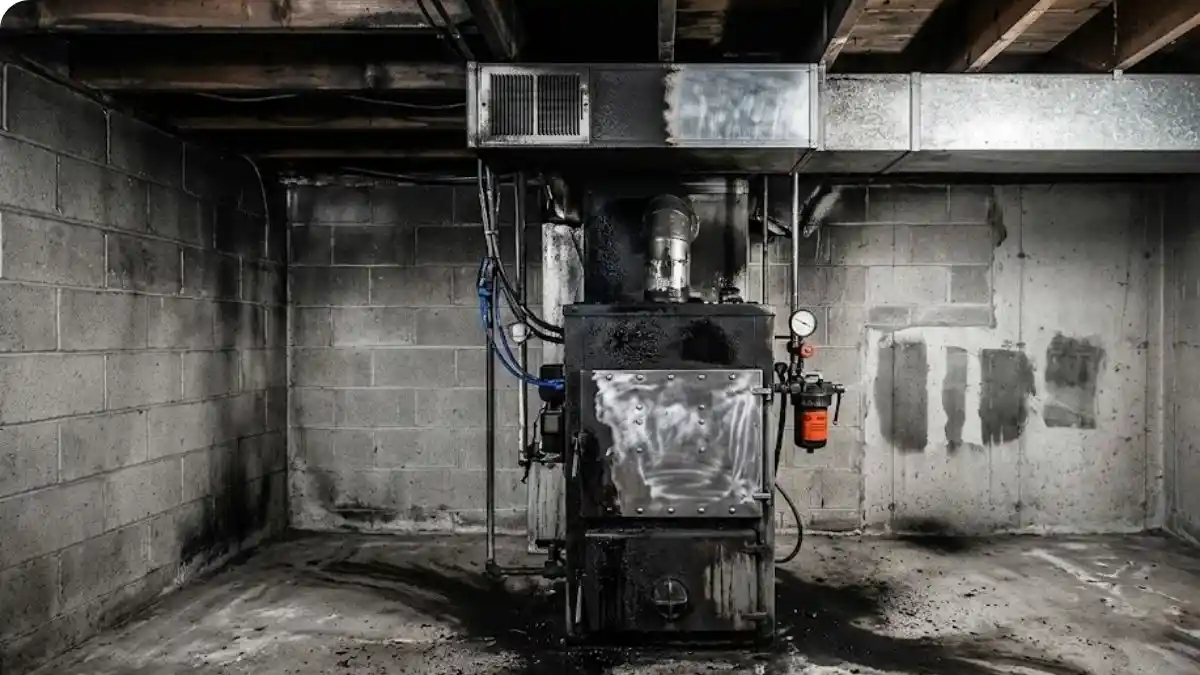
A furnace puffback can happen in seconds: one misfire event in the combustion chamber, and oily black soot is forced backward through the exhaust system into the ductwork. From there, the forced-air system distributes it throughout the home. Within minutes, every room served by the heating system has soot on walls, ceilings, furniture, and inside closets. The oily residue is petroleum-based, so it does not behave like ordinary dust — wiping it spreads it, and standard cleaners do not lift it. Professional cleanup is not optional.
Call (703) 397-8315 for furnace puffback soot cleanup in Fairfax, VA.
Why Puffback Is Common in Fairfax County’s Older Housing Stock
Fairfax County has a significant concentration of homes built between the mid-1950s and early 1980s that were originally heated with oil-fired systems. Many of these systems have been maintained but not replaced, and they operate at a higher risk of puffback than modern systems for several reasons: original nozzles wear over time and spray inconsistently; older igniter systems produce unreliable ignition; and extended periods of low oil use (summer months) allow residue to accumulate around the nozzle that disrupts the first burn of the heating season.
Neighborhoods in Annandale, Springfield, North Springfield, Cobbdale, Old Lee Hills, and Vienna have high concentrations of this housing era. If your home has an oil-fired furnace or boiler, annual maintenance by a qualified oil burner technician is the primary prevention tool. A puffback that occurs after years without service is more severe than one caught early.
The Chemistry of Puffback Soot
Puffback soot is oily soot — the same category as soot from smoldering synthetic materials, but derived from petroleum-based fuel oil. This makes it chemically distinct from dry carbon soot from a wood fire. Petroleum-based soot is greasy and adhesive; it sticks aggressively to painted surfaces, fabric fibers, and porous materials, and it resists removal by water-based cleaners. Wiping it with a dry cloth does not remove it — it smears the oily residue across a larger area and can drive it deeper into porous surfaces.
Proper cleaning requires chemical degreasers and solvent-based agents formulated for oily soot. Even after thorough cleaning, oily puffback residue often bleeds through standard paint when surfaces are repainted, requiring an encapsulating primer or sealant coat before refinishing.
| Puffback Scope | Affected Area | Typical Cleanup Time | Notes |
|---|---|---|---|
| Minor puffback | Utility room / boiler room only | 1 day | Rare — most puffbacks travel through ductwork |
| Moderate puffback | Main living level + HVAC | 2-4 days | Most common; oily residue on walls, ceilings, contents |
| Significant puffback | Multiple floors + all HVAC runs | 4-7 days | Often requires surface sealing before repainting |
| Severe puffback | Whole-home contamination | 1+ week | Older homes with unlined ductwork; full pack-out may be needed |
Sequence: Furnace Off, HVAC Off, Then Cleanup Begins
Before any cleanup begins, the furnace must be shut off and the HVAC system disabled. Running the HVAC with soot in the ductwork redistributes contamination into every room continuously. The furnace must be serviced and cleared by a qualified oil burner technician before it is operated again — a second puffback during or after cleanup recontaminates everything. We coordinate our scope around this sequence.
Our cleanup process starts with covering all return air vents to prevent loose soot from being drawn into the system during cleaning, then working room by room: HEPA vacuuming loose particulate from all surfaces, chemical degreasing of walls and ceilings, surface cleaning of contents, and finally ductwork cleaning as the last step before the system can be restarted.
Room-by-Room Cleaning Process
Puffback soot is present on every surface in every room served by the ductwork. The cleaning sequence matters. If soot is disturbed on ceilings and walls before floor surfaces and contents are protected, the disturbed particulate resettles on areas already cleaned. We work top-to-bottom, ceiling to floor, and seal registers before working near them to prevent drawing loosened soot into the duct system.
Closets, interior door surfaces, ceiling fan blades, light fixture housings, and the interiors of cabinets and drawers are all contaminated by puffback soot and all require cleaning. These are the areas most commonly missed in inadequate cleanup attempts, and they become ongoing odor and residue sources if left untreated.
HVAC and Ductwork Cleaning After Puffback
The ductwork is the distribution system for puffback soot, and it must be cleaned as the final step before the furnace is restarted. Soot inside duct runs, on air handler coil surfaces, and inside the blower assembly is redistributed into every room on the first heating cycle after service if not removed. We clean all accessible duct runs using HEPA-equipped tools, wipe register boots and diffusers, and clean the air handler cabinet interior. Flexible insulated ductwork with heavy internal soot contamination may require replacement rather than cleaning.
Ductwork cleaning is the end point of puffback cleanup, not the starting point. Cleaning ducts before cleaning rooms means running a cleaning tool through contaminated ducts while rooms are still coated in soot. We sequence the work correctly.
Coordination with Your Oil Burner Technician
Cleanup and mechanical service are parallel tracks that must coordinate. Your oil burner technician identifies and corrects the cause of the puffback — whether that is a worn nozzle, inconsistent igniter, blocked flue component, or another mechanical issue — and clears the furnace for operation. We handle the soot cleanup and ductwork. Before the furnace runs again, both tracks must be complete. We are accustomed to this coordination and can work around the technician’s schedule on the HVAC timing.