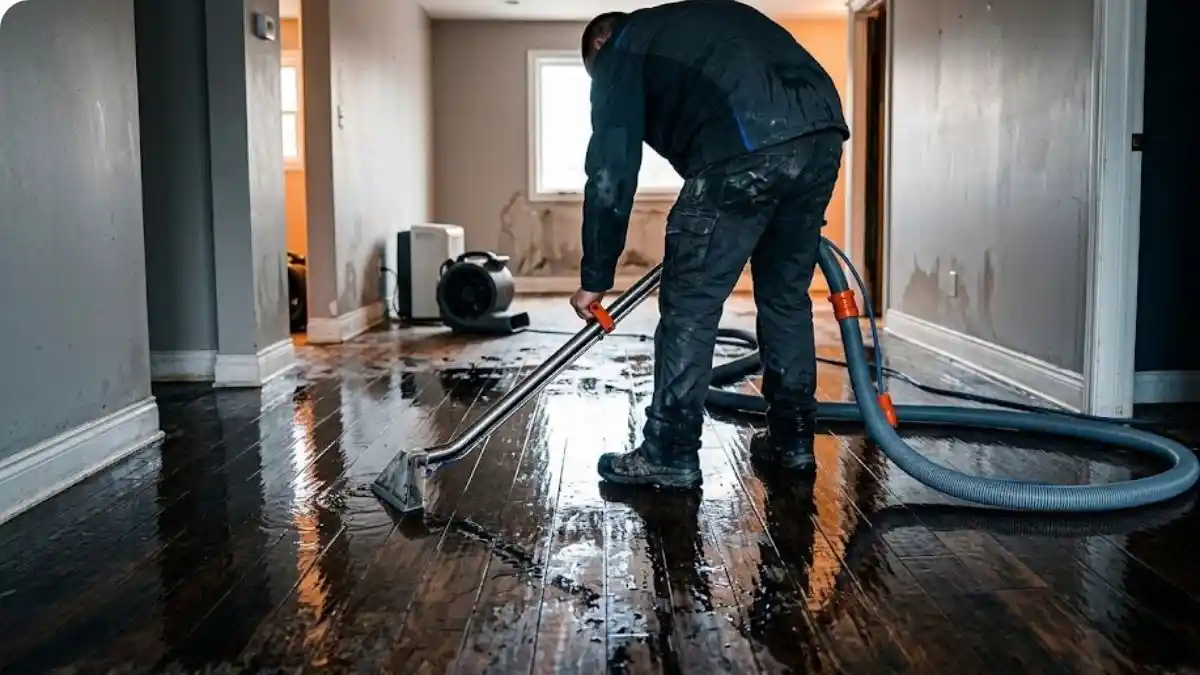
Standing water in a home or business begins causing secondary damage immediately. Within one hour, water wicks into drywall, insulation, and flooring. Within 24 to 48 hours, mold colonization begins on wet surfaces — earlier in Fairfax County’s humid summer months. The structural drying window that prevents mold and permanent material damage is counted in hours, not days. Speed and the right equipment are what separate a manageable water event from a mold remediation project.
Call (703) 397-8315 for emergency water removal in Fairfax, VA — 24/7.
Water Damage Categories and What They Mean
Not all water damage is the same. The IICRC S500 standard classifies water intrusion by contamination level, which determines the cleanup protocol, what materials can be dried in place versus must be removed, and what antimicrobial treatments are required. Misclassifying water category leads to inadequate cleanup and unresolved health hazards.
| Water Category | Source | Health Risk | Protocol |
|---|---|---|---|
| Category 1 (Clean) | Supply lines, clean appliances, rain intrusion | Low at time of loss | Standard extraction and drying; escalates if left 24+ hrs |
| Category 2 (Gray) | Dishwasher overflow, washing machine, HVAC condensate | Moderate — contaminants present | Extraction, antimicrobial treatment, controlled drying |
| Category 3 (Black) | Sewage backup, toilet overflow, floodwater | High — pathogens present | Full biohazard protocols; affected porous materials removed |
High-Volume Water Extraction
The first priority is removing standing water. We use truck-mounted extraction units with high-lift capacity for large volumes of standing water, and portable extraction wands for precise work in finished spaces where truck-mount hose reach is limited. Carpet and pad are extracted first, then hard surface floors, then water from inside wall cavities via injectidry probes if the cavity is wet. Every category of water source is extracted before drying equipment is positioned.
Fairfax County’s clay-heavy soil creates specific basement flooding patterns. Clay soil retains water near foundations and creates hydrostatic pressure against basement walls during prolonged rain. This means water in a flooded basement may still be entering even as we extract, particularly if the sump pump has failed or is undersized for the event. We assess active water entry and address the source before extraction can be effective.
Structural Drying with LGR Dehumidifiers and Air Movers
After extraction, moisture remains inside structural materials: the drywall paper has absorbed it, the insulation is saturated, the subfloor has wicked it up from below. This moisture cannot be extracted — it must be evaporated from the material and then captured from the air. Low-grain refrigerant (LGR) dehumidifiers run continuously, pulling moisture from the air at low humidity levels that standard dehumidifiers cannot achieve. High-velocity air movers position airflow across wet surfaces to accelerate evaporation from the material surface into the air column, where the dehumidifier captures it.
Equipment placement is not arbitrary. We use psychrometric calculations to position air movers at angles and distances that create targeted airflow across wet structural surfaces. Daily moisture readings with calibrated meters track drying progress at structural materials, not just air humidity. Equipment stays until readings confirm structural materials have reached IICRC-standard moisture content.
Moisture Mapping and Hidden Water
Visible water is only part of the picture. Water wicks through drywall, travels under flooring, and migrates through wall insulation to locations far from the visible intrusion point. A finished basement with 4 inches of standing water may have moisture 18 to 24 inches up drywall walls, wet insulation inside wall bays, and saturated subfloor materials that show no visible surface moisture after extraction.
We use calibrated pin and non-invasive moisture meters to map the extent of wet materials throughout the affected area. This moisture map documents the scope of damage, guides equipment placement, and creates a baseline for measuring drying progress. We re-map daily. The map also goes to your insurance adjuster as documentation of the damage extent.
Hardwood Floor Drying
Hardwood floors are among the most challenging materials to dry in a water damage event. Wood absorbs moisture and expands; when wet, individual boards cup and buckle as they try to expand against adjacent boards. Rapid drying causes dimensional changes that can split boards or create gaps. Controlled drying using specialized floor drying systems — flat mats or chamber systems that circulate dry air directly across the floor surface — allows moisture to leave the wood slowly enough to minimize cupping and maximize salvage rate.
We assess hardwood flooring at the time of extraction and document whether the moisture content is within the range where drying-in-place is viable versus where removal is required. Older Fairfax homes with original hardwood are particularly worth attempting to save given the difficulty of matching vintage floor materials.
Mold Prevention Is the Goal
The primary purpose of rapid extraction and structural drying is mold prevention. Mold spores are present in ambient air in every building. When structural materials remain above the moisture threshold that supports mold growth for more than 24 to 48 hours, colonization begins — faster in Fairfax County during humid summer months. Once mold establishes in wall framing and insulation, the project changes from a drying project to a remediation project with significantly higher cost and complexity. Getting drying equipment in place within the first hours after water intrusion is the intervention that prevents this outcome.
If mold is already present when we arrive, see our mold remediation page for how that scope is handled.