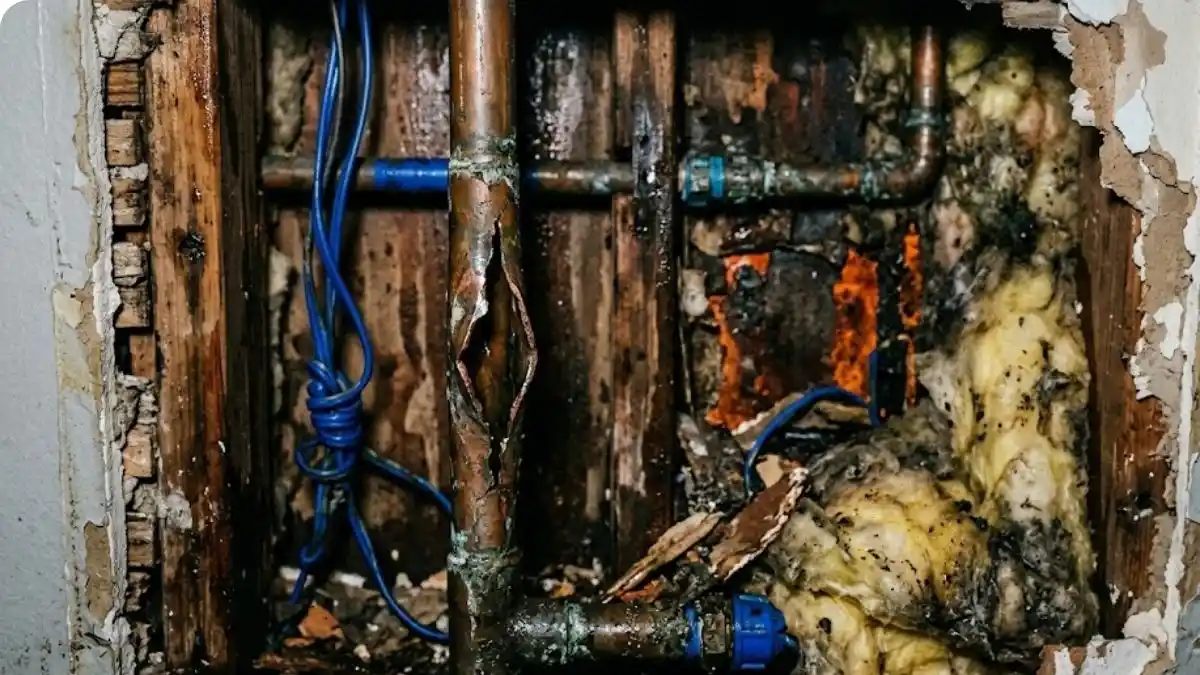
A burst supply line delivers water at full line pressure until someone shuts off the main. In a home where the burst goes undetected — inside an exterior wall cavity, under a floor, or during an unoccupied vacation period — the volume of water introduced before discovery can be substantial. The cleanup scope expands significantly with each hour the water runs.
Call (703) 397-8315 for burst and frozen pipe cleanup in Fairfax, VA — 24/7.
Frozen Pipe Risk in Fairfax County Homes
Fairfax County's winters include periodic cold snaps that drop temperatures into the single digits for multi-day stretches, most commonly in January and February. Supply lines in exterior wall cavities, in crawlspaces under poorly insulated floors, and in unheated garage walls are vulnerable. The freeze-and-burst sequence is often delayed from the temperature event: pipes freeze during the cold period, then burst when temperatures rise and the ice plug melts, allowing water pressure to force through the compromised pipe.
Homes that are unoccupied during cold weather — travel or seasonal vacancy — face elevated risk because temperature setback thermostats allow ambient temperatures in exterior wall cavities to drop below freezing even when interior spaces are held at 55 degrees. A thermostat set to 55 degrees does not protect an uninsulated pipe in an exterior wall cavity when outdoor temperatures reach zero.
| Pipe Failure Type | Water Category | Typical Scope | Fairfax Risk Factor |
|---|---|---|---|
| Frozen pipe burst (exterior wall) | Category 1 | Wall cavity, floor, adjacent rooms | January–February cold snaps; exterior wall cavities in older homes |
| Supply line failure (under sink) | Category 1 to 2 within 24h | Cabinet, floor, subfloor, adjacent rooms | Older braided supply lines; rubber deterioration |
| Slab leak | Category 1 | Slab, flooring, wall bases, broad floor area | Homes on concrete slab foundation throughout Fairfax County |
| Vacation / unattended burst | Escalates to Cat 2–3 over time | Potentially whole-home | Thermostat setback in empty home during cold snap |
| Supply line behind appliance | Category 1 to 2 | Floor, wall, potentially subfloor | Fridge, washing machine, dishwasher lines — see S5 |
Shutting Off the Water Supply First
The first step when a pipe burst is discovered is shutting off the main water supply to stop the flow. This is not an obvious step when water is actively falling through a ceiling or spreading across a floor, but calling for water removal before the source is shut off means the scope continues to grow throughout the response. Know where your main shutoff is before an emergency occurs. If you cannot locate or operate it, your utility provider can shut off at the meter.
After the main is off and the immediate flow has stopped, call us. We assess the extent of water spread — which is often larger than the visible wet area suggests, because water travels along wall cavities, under flooring, and through structural penetrations.
Hidden Water Spread After a Pipe Burst
Water from a burst supply pipe does not stay where it is visible. It follows framing members, travels along top plates into adjacent rooms, wicks into drywall from above and below, and migrates under flooring across large areas. A burst pipe in a second-floor bathroom can produce wet ceilings and walls in first-floor rooms directly below, and water can travel laterally along the floor assembly to affect rooms not directly under the break. Our moisture mapping process uses calibrated pin and non-invasive meters to document the full extent of water spread before any equipment is positioned.
Slab Leak Water Damage
Homes built on concrete slab foundations throughout Fairfax County have supply and drain lines that run beneath the slab. When these lines fail, water enters through the slab and saturates the floor assembly from below — hardwood, laminate, tile, and vinyl flooring all absorb moisture from beneath before any visible surface sign appears. By the time a homeowner notices moisture or soft spots, the subfloor and floor assembly may have been wet for days or weeks.
We handle the water damage remediation side of a slab leak: moisture mapping the extent of floor saturation, extracting accessible water, removing flooring to expose the subfloor assembly, and running structural drying equipment until readings confirm dryness. The pipe repair itself is coordinated with your plumber. We document the moisture extent before any flooring removal so the pre-remediation scope is clear for insurance purposes.
Unattended Home Burst: Scope and Sequence
When a pipe bursts in an unoccupied home and is not discovered for days, the water damage scope typically includes multiple rooms, saturated structural assemblies, and often active mold growth. The sequence changes compared to a fresh event: muck-out of any standing water that has picked up debris, assessment of structural integrity of wet assemblies, removal of all compromised materials rather than drying in place, and mold assessment before clearance. If mold is present, our mold remediation service runs concurrently with the drying scope.