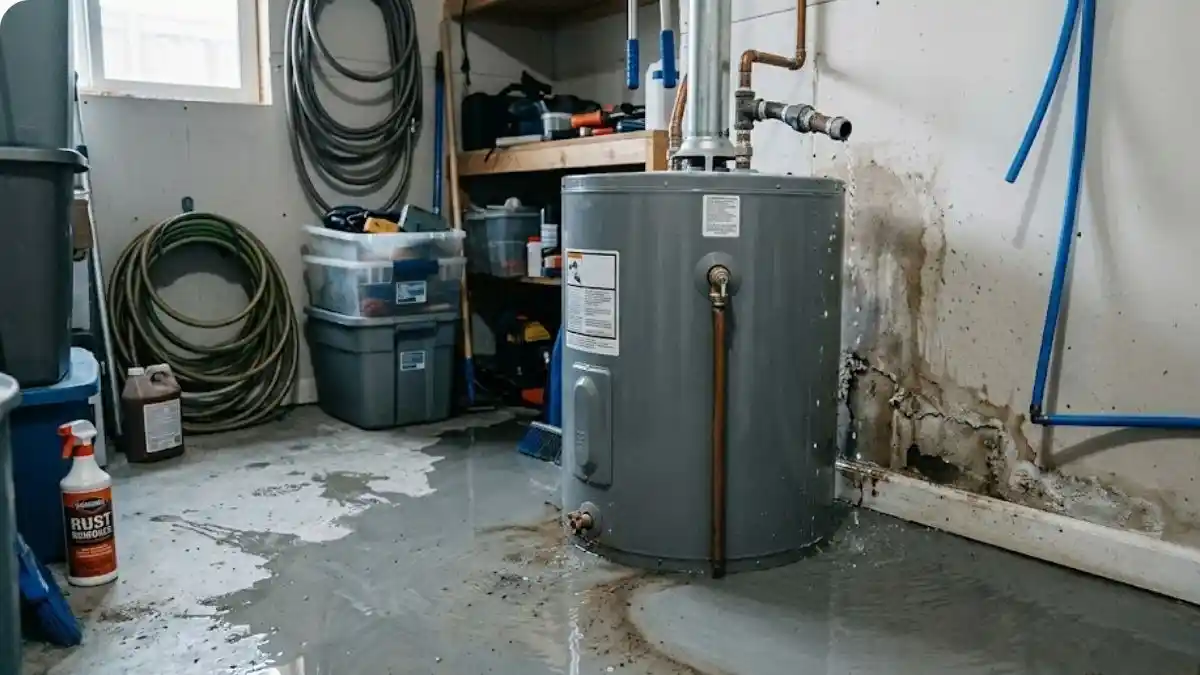
Appliance water failures share a frustrating characteristic: they often go undetected long enough to cause significantly more damage than the initial failure alone. A refrigerator ice maker line with a pinhole failure drips for weeks under the refrigerator before the floor discoloration appears. A water heater with slow tank corrosion weeps into the utility room for months before anyone notices the stain on the drywall base. When they do fail catastrophically, the volume is immediate and large.
Call (703) 397-8315 for appliance and water heater flood cleanup in Fairfax, VA — 24/7.
Washing Machine Flood Cleanup
Washing machine supply hose failures are among the most common sudden water damage events in residential properties. Standard rubber supply hoses degrade over time and fail at connections; braided stainless steel hoses are more durable but not immune to fitting failures. When a supply hose fails during a wash cycle, water flows at full domestic water pressure — typically 40 to 80 PSI — until the cycle ends or someone shuts off the supply. A single wash cycle running on a failed hose can introduce hundreds of gallons of water.
In homes with laundry rooms on upper floors, the water migrates through the floor assembly to affect ceilings and walls below. We assess the ceiling damage below laundry areas as part of every washing machine flood scope — not as an afterthought if the homeowner notices a stain later.
| Appliance | Failure Mode | Typical Volume | Primary Damage Zone |
|---|---|---|---|
| Washing machine | Supply hose burst at wall or machine connection | Continuous at line pressure until shutoff | Laundry room floor, subfloor, ceiling below if upper floor |
| Water heater (tank) | Tank corrosion / rupture / pressure valve failure | 40–80 gal tank + continuous supply line | Utility room floor, adjacent subfloor, wall bases |
| Dishwasher | Door gasket, drain hose, supply line connection | Contained per wash cycle — can recur if undetected | Under-sink cabinet, kitchen floor, subfloor |
| Refrigerator ice maker line | Compression fitting failure or kink | Slow drip — often undetected for weeks | Under refrigerator, floor, wall base, subfloor |
| HVAC condensate drain | Clogged drain pan; line blockage | Slow drip; accumulates if unchecked | Ceiling below air handler; drywall around handler cabinet |
| Boiler / radiator failure | Fitting failure, pressure relief, radiator crack | Variable | Flooring, baseboard, wall materials in affected rooms |
Water Heater Burst and Tank Failure
Standard tank water heaters have a service life of 8 to 12 years. As a tank approaches end of life, corrosion inside the tank progressively weakens the wall. A slow weep from a corroded fitting or a pressure relief valve discharge can precede a more significant failure; a sudden tank rupture releases the full tank volume immediately. In Fairfax County homes with water heaters in basement utility rooms, the water spreads across the concrete floor and migrates under walls into finished areas rapidly.
The cleanup scope for a water heater failure includes extracting all water from the utility room and adjacent spaces, removing wet insulation from affected wall bases, moisture mapping the full extent of water spread, and running structural drying equipment. The failed water heater is removed by the plumber or homeowner as part of the appliance replacement; our scope is the water damage to the building.
Dishwasher and Under-Sink Leaks
Dishwasher leaks originate at the door gasket, the drain hose connection to the disposal or drain, or the supply line connection under the sink. A door gasket failure that occurs on every cycle can saturate the kitchen floor and subfloor through repeated small intrusions before becoming obvious. Under-sink cabinet flooding from a dishwasher line failure typically saturates the cabinet floor, the kitchen flooring directly adjacent, and the subfloor below. We assess subfloor moisture under kitchen flooring as part of every dishwasher flood scope because surface flooring that appears intact may be sitting on a saturated subfloor.
Refrigerator Ice Maker and Water Line Failures
Refrigerator water line failures are often slow-drip events that accumulate over weeks or months under the refrigerator before becoming visible. The water migrates under the refrigerator, through vinyl or tile flooring, and into the subfloor layer below. By the time a homeowner moves the refrigerator and sees the staining, the subfloor has been wet long enough for mold to establish. We use non-invasive moisture meters to assess subfloor moisture under flooring in the refrigerator area and adjacent flooring sections, then determine whether the subfloor can be dried in place or must be removed for access.
HVAC Condensate Drain Failures
In Fairfax County's humid summers, central air conditioning systems produce significant condensate that drains through a PVC line to a floor drain or exterior discharge point. When this drain line clogs — which occurs regularly when algae or debris blocks the line — the drain pan overflows. Depending on where the air handler is located, an overflowing drain pan can produce ceiling water damage below the unit, wet insulation around the air handler cabinet, and drywall saturation in the surrounding area. We handle HVAC condensate overflow water damage as part of our appliance flood scope.