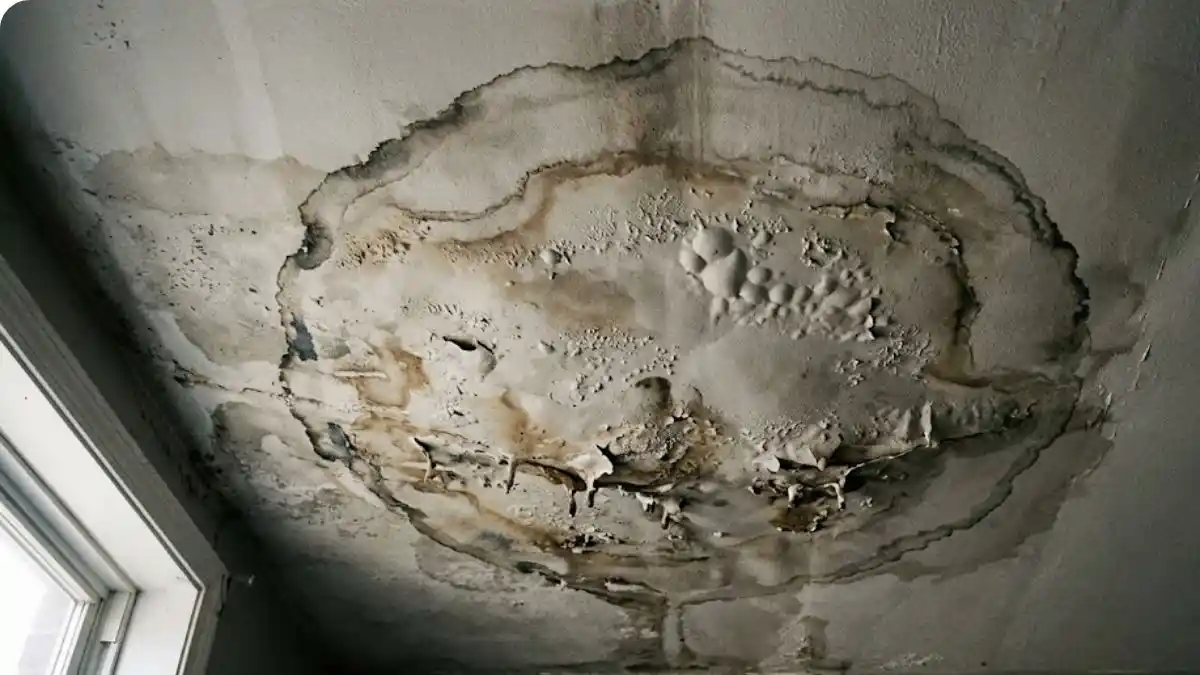
A water stain on your ceiling is almost never just a cosmetic problem. By the time a stain is visible from below, water has already saturated the drywall, wicked into the framing above it, and likely accumulated in the insulation layer. The visible stain represents the leading edge of a moisture intrusion that started somewhere else and traveled to its lowest point before pooling enough to show through.
Call (703) 397-8315 for ceiling water damage restoration in Fairfax, VA — 24/7.
Identifying the Source Before Treating the Symptom
The stain on the ceiling is where the water ended up, not necessarily where it came from. A stain below a second-floor bathroom may originate at the toilet wax ring, the supply line connection, the shower pan, or a supply stub-out in the wall. A stain near an exterior wall may be roof intrusion or ice dam meltwater. A stain near a ceiling register almost always points to the HVAC condensate drain. Correctly identifying the source determines whether the water entry is ongoing, how far the moisture has spread in the ceiling cavity, and what repair sequence is needed.
We inspect above the ceiling — in the attic or through a ceiling cavity access point — to trace moisture to its origin before any drying equipment is placed. Starting a drying scope without confirming the source is closed means running equipment against an active water entry.
| Ceiling Water Source | Staining Pattern | First Step | Common Fairfax Context |
|---|---|---|---|
| Upstairs bathroom leak (toilet / supply line) | Concentrated ring stain below fixture | Shut off water supply; confirm source | Common in 1970s–1980s bathrooms with original supply lines |
| Shower pan or tub overflow failure | Diffuse staining across bathroom floor area below | Stop use of shower; dry pan area before testing | Tile-over-pan failures common in older Fairfax townhomes |
| Roof intrusion / storm damage | Staining at roof penetrations, skylights, valleys | Tarp roof before rain returns | Summer storm shingle displacement throughout Fairfax County |
| HVAC condensate drain clog | Staining near air handler cabinet or ceiling registers | Clear drain line; shut off AC | Summer peak — high condensate production in Fairfax humidity |
| Ice dam intrusion | Staining at exterior walls, top-floor ceilings | Remove snow load from roof edge if safe | January–February events; north-facing roofs in older Fairfax homes |
Water Coming Through the Ceiling from the Unit Above
In Fairfax County condominiums and multi-story townhomes, water through the ceiling originates from the unit or floor above. This creates an insurance coordination question: the damage in your unit may be caused by a failure in your neighbor's unit, creating a claim against their policy, your own policy, or the building master policy depending on the HOA structure and the nature of the failure. We document the damage in your unit thoroughly regardless of which coverage ultimately responds, and we can coordinate with the upstairs unit if access is needed for moisture mapping.
Ice Dam Interior Damage
Ice dams form when heat loss through a roof causes snow to melt and refreeze at the cold eaves. The ice dam blocks meltwater drainage, forcing water under shingles and through the roof deck into the attic insulation and ceiling below. Ice dam events in Fairfax County occur during January and February cold snaps and typically produce ceiling staining along exterior walls and at top-floor ceilings beneath poorly insulated attic spaces.
Ice dam water intrusion often goes undetected during the winter event and is only discovered when spring warmth causes the remaining ice to melt and the full volume of accumulated water releases through the ceiling simultaneously. By that point, the ceiling insulation has been saturated for weeks and mold assessment is warranted before the ceiling is repaired.
Drying the Ceiling Cavity
After the source is confirmed closed, ceiling drying requires equipment above and below the wet assembly when attic access permits. Air movers positioned below the ceiling accelerate evaporation from the drywall surface; equipment in the attic addresses the insulation layer and framing above. Insulation that has been saturated for more than 24 to 48 hours typically must be removed — fiberglass batt insulation holds moisture for weeks when sealed above wet drywall, and it cannot be effectively dried in place.
Ceiling drywall that has lost structural integrity — sagging, delaminating, or actively wet — must be replaced rather than dried. We assess drywall condition with moisture meters and document the determination for insurance purposes. Replacement is coordinated with your reconstruction contractor after the structural drying scope is complete and clearance moisture readings are confirmed.
Mold Risk in Wet Ceiling Cavities
Ceiling cavities are enclosed spaces with limited airflow and organic material (drywall paper, wood framing) that mold colonizes rapidly when wet. A ceiling that has been wet for more than 48 hours in Fairfax County's climate warrants mold assessment before repairs are made. Closing up a ceiling cavity with mold growth inside creates a hidden reservoir that causes recurring odor and potential air quality problems. We flag any visible mold during the drying scope and coordinate with our mold remediation team when growth is present.