Published 2025-09-17 · Fairfax Fire & Water Specialists
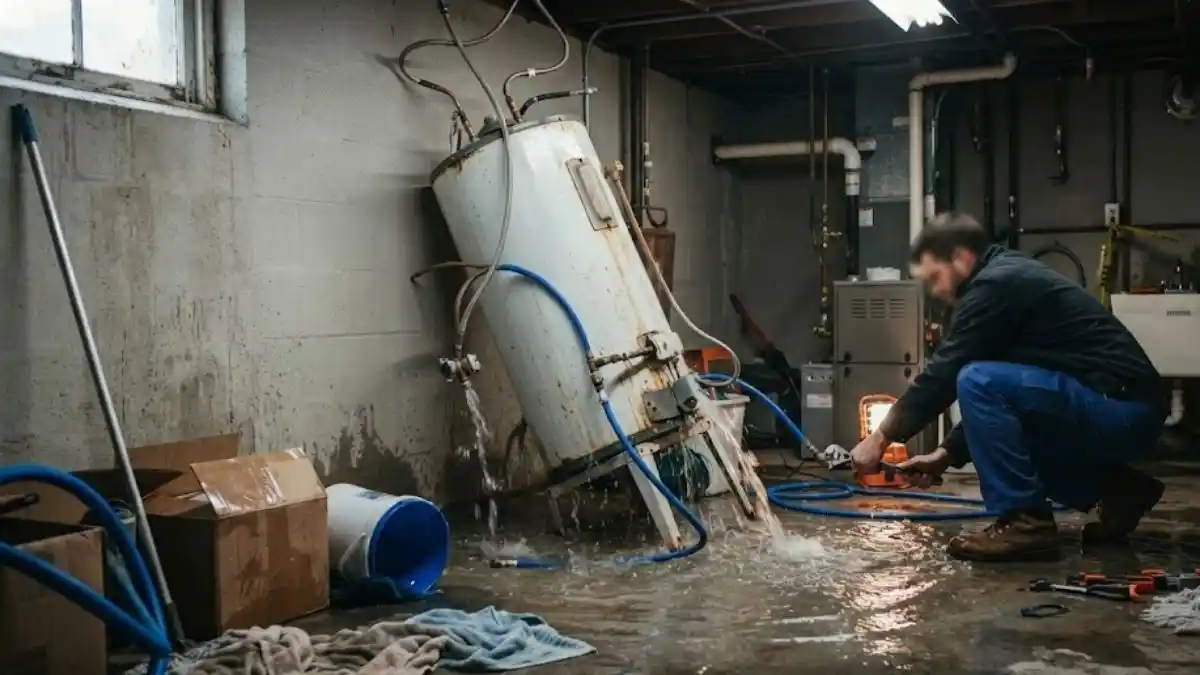
A water heater does not usually fail dramatically. More often it gives months of subtle signs — a small puddle that appears and disappears near the base, a faint sulfur smell when the hot water runs, a unit that takes longer than it used to reach temperature — before the tank wall finally fails and releases its full contents. When a water heater does fail completely, the results in a Fairfax County utility room can spread beyond the immediate room faster than most homeowners expect.
How Water Heater Failures Progress
Standard tank water heaters have a service life of 8 to 12 years. As a tank approaches the end of that range, internal corrosion from the anode rod losing effectiveness allows the interior tank wall to weaken progressively. A slow weep from a corroding fitting or the temperature-pressure relief valve precedes a more significant failure in some cases; in others, a tank that appeared dry until the day it failed produces a sudden rupture. Either way, the result is 40 to 80 gallons of hot water on the utility room floor, followed by continuous inflow from the cold supply line until someone shuts off the supply valve.
In Fairfax County homes where the water heater is in a basement utility room, that volume of water spreads across the concrete floor within minutes and migrates under walls into adjacent finished areas, and water coming through the ceiling in rooms below may also result. A finished basement adjacent to the utility room — common in 1980s construction throughout Burke, West Springfield, and Centreville — can have four to six inches of water in the recreation room before the homeowner realizes what has happened.
Shutting Off the Supply Valve First
The cold supply valve for the water heater is located above the unit on the cold water inlet pipe. Closing this valve stops inflow from the supply line immediately. If you cannot locate or operate this valve, the main water shutoff to the house accomplishes the same result. Calling for extraction help before shutting off the supply means the scope is still growing during the call. Stop the source first.
After the supply is off, turn off the water heater's power or gas supply. A gas water heater with a failed tank that continues to receive heat input to an empty or low-water tank is a safety issue.
Water Spread Beyond the Utility Room
The volume from a water heater failure is sufficient to migrate well beyond the immediate utility area. Water travels under wall plates into adjacent rooms, wicks up drywall from the floor, and in two-story configurations, can travel through the floor assembly to affect ceiling areas below, including ceiling staining and drywall damage in rooms below. Our appliance and water heater flood cleanup crew assesses moisture spread in all adjacent areas as part of the initial evaluation — we do not assume the scope ends at the utility room door.
Calibrated moisture meters measure moisture content at structural materials in the affected areas. The full extent of water spread is documented in writing and photographically for your insurance carrier before extraction begins.
Drying Concrete vs Finished Floor Assemblies
Water heater failures in utility areas with exposed concrete floors are the simpler scenario: extract the water, clean the slab, run drying equipment, confirm dryness. The harder scenario is when the water has migrated under a wall into a finished area with carpet, pad, drywall, and insulation. Carpet and pad come out; they cannot be effectively dried in place and hold moisture against the subfloor. Drywall at the floor level must be assessed for saturation height; if the water wicked more than a few inches up the wall, flood cut and insulation removal follows.
Our emergency water removal and structural drying service handles both scenarios with extraction, flood cut decision documentation, and IICRC S500-standard drying confirmation.
Insurance for Water Heater Burst in Fairfax County
Standard HO-3 policies cover sudden and accidental water damage from a water heater failure. Coverage extends to the water damage to the structure and contents; the water heater itself may or may not be covered depending on policy terms (some policies cover the appliance as personal property, others do not). We document the event scope and condition for your adjuster in the format that supports efficient claim processing.
For water heater burst cleanup throughout Fairfax County — Springfield, Burke, Centreville, Kingstowne, Lorton, and surrounding communities — call (703) 397-8315.