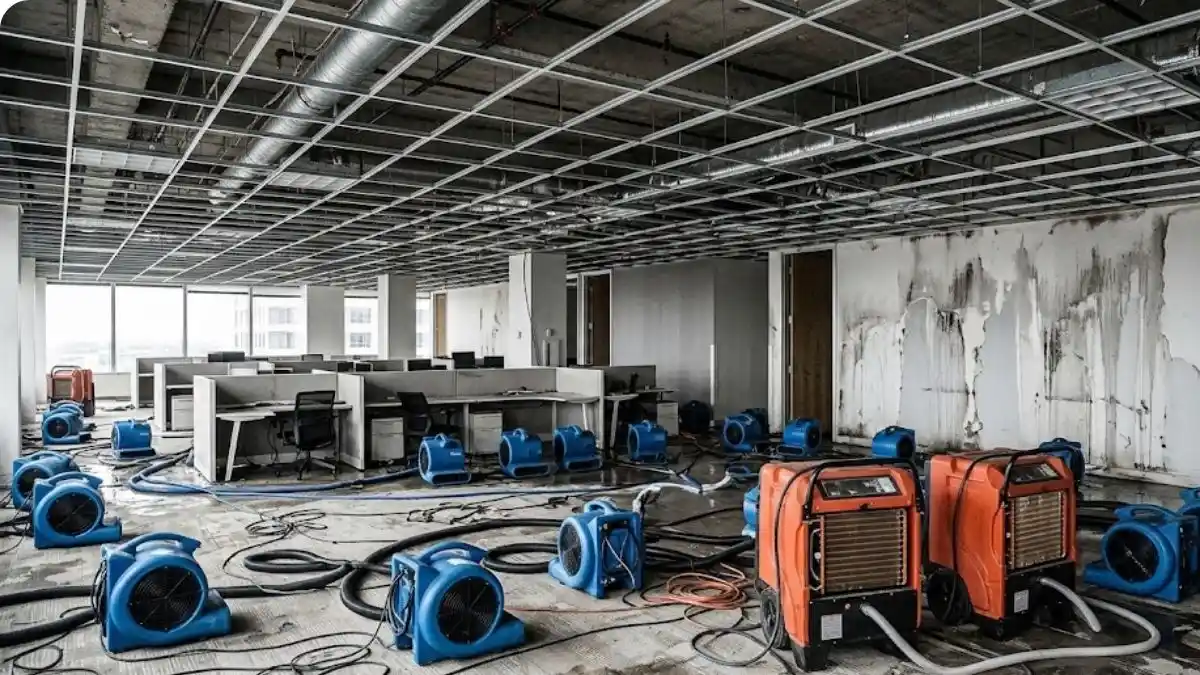
Commercial property damage operates on a different timeline and set of constraints than residential work. A flooded office cannot wait until Monday morning. A fire-damaged retail space has lease obligations and customer commitments that a homeowner does not. Large commercial losses — multi-floor water intrusion, fire across a building wing — require project management capacity, not just restoration crew capacity.
Call (703) 397-8315 for commercial damage restoration in Fairfax, VA — 24/7.
Commercial Water Damage Restoration
Commercial water intrusion events — plumbing failures, roof leaks, and HVAC failures — affect not just the structure but the operations inside it. Water in a server room, across an inventory warehouse floor, or through a drop ceiling into an open office requires rapid response that minimizes downtime while meeting IICRC S500 drying standards. We coordinate access around your schedule, work outside business hours when required, and communicate daily scope progress to property managers and commercial insurance adjusters.
Fairfax County's commercial inventory includes older office buildings along Route 50 and Lee Highway, retail centers at Fairfax Corner and Fair Lakes, and multi-story mixed-use buildings near George Mason University — each with different building system configurations and tenant coordination requirements.
| Commercial Event Type | Primary Scope | Business Continuity Factor |
|---|---|---|
| Fire sprinkler discharge | Large-volume water across sprinkler zone; ceiling and floor below | Zone isolation may allow partial operations during cleanup |
| Commercial fire damage | Smoke/soot throughout HVAC zones; structural involvement variable | Board-up and air quality required before staff return |
| Roof leak / storm intrusion | Ceiling and IT/electrical risk; inventory exposure | Tarping + extraction often allows same-day partial access |
| Plumbing failure (supply or drain) | Flooring, wall bases, subfloor; multi-floor if upper story | Source isolation restores water service to rest of building |
| Commercial mold | HVAC-distributed spores; remediation containment required | Containment protocols limit but do not always stop operations |
| Sewage backup (commercial) | Cat 3 protocols; full porous material removal in affected zone | Affected area closed; rest of building unaffected typically |
Fire Sprinkler Discharge Cleanup
A fire sprinkler activation — whether from an actual fire event or an accidental activation from heat or mechanical failure — delivers large volumes of water from overhead across the zone served by the activated heads. Sprinkler water distributes across commercial flooring, penetrates drop ceiling tiles and the structural ceiling above, migrates through floor assemblies into the level below, and saturates any contents in the affected zone. Electrical panels, IT infrastructure, and server rooms in the activation zone require immediate assessment before power is restored.
We treat sprinkler discharge cleanup as a large-scale extraction and drying project with the added complexity of protecting sensitive equipment areas and coordinating with the building's fire suppression contractor who must restore the system before the space can be released for occupancy.
Commercial Fire and Smoke Damage
Commercial fire and smoke restoration differs from residential in scale and in stakeholder complexity. A fire in a multi-tenant commercial building affects the building owner, the directly impacted tenant, adjacent tenants who may have smoke infiltration, and the commercial insurer. Our scope covers the structural and systems assessment for the building owner, the contents and smoke cleanup for the affected tenant, and the air quality evaluation relevant to adjacent tenant areas.
Large commercial fire losses are managed as projects with designated scope coordinators, daily progress reporting, and structured communication to all parties. We do not treat commercial fire restoration as an oversized residential job.
Commercial Mold Remediation
Commercial buildings with HVAC systems that distribute air throughout large floor plates present mold contamination scenarios that residential HVAC systems do not. Mold established in an air handler unit or in a section of return ductwork can distribute spores throughout the entire floor area served by that system. Commercial mold remediation requires HVAC assessment and containment before remediation of the source material, with clearance testing that confirms spore counts are within acceptable ranges across the served area before the HVAC system is returned to normal operation.
See our mold remediation page for detail on the remediation process; commercial mold scopes follow the same IICRC S520 standards with additional project coordination for occupied commercial buildings.
Documentation for Commercial Insurance Claims
Commercial property insurance claims involve adjusters who follow structured documentation requirements different from residential claim formats. We provide moisture readings with IICRC S500 reference documentation, photographic scope evidence organized by building zone, and written scope narratives that match commercial adjuster documentation protocols. We have experience coordinating with commercial carriers and third-party administrators in Fairfax County office and retail properties. See our insurance claims page for additional detail on documentation.