Published 2025-09-03 · Fairfax Fire & Water Specialists
Most Fairfax County homeowners go through the water damage insurance claim process once or twice in their lives. The unfamiliarity of it — the sequence of calls, what to document, what the adjuster is looking for, and what language in the policy matters — is what makes it feel more complicated than it is. This guide covers the process from first call through documentation, written for homeowners who have not done this before.
The First Call: Carrier or Contractor?
The most common question in the first hour is whether to call your insurance carrier or a restoration company first. The practical answer: do both, in whatever order you can manage quickly. The reason to call a restoration company promptly is your mitigation obligation — your policy requires you to take reasonable steps to prevent further loss after a covered event. Standing water left in a basement for 48 hours creates mold; a burst pipe running through the night creates five times the water damage of one caught immediately. Beginning water extraction and structural drying is the mitigation step your policy expects.
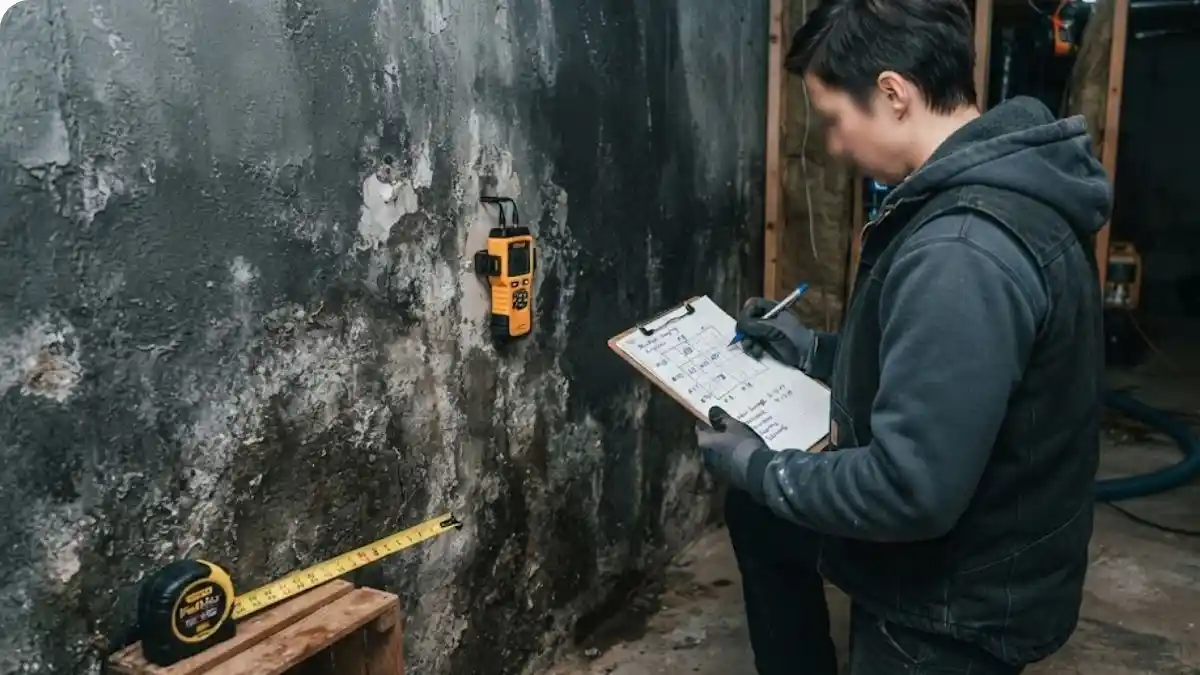
Our crew documents conditions on arrival before any extraction begins. That documentation — photographs and moisture readings taken at the moment of response — is the pre-mitigation baseline your adjuster needs. It cannot be recreated after the fact.
What "Sudden and Accidental" Means
Standard HO-3 policies cover water damage that is sudden and accidental from a covered peril. A pipe that burst on a specific day from a freeze event is sudden. An appliance that failed and flooded a laundry room is sudden. These are covered. A pipe that dripped behind a wall for three months before the ceiling collapsed is not sudden; it is gradual damage, which is explicitly excluded from most HO policies because the homeowner had an obligation to discover and address an ongoing leak during routine maintenance.
Adjusters are trained to look for signs that distinguish sudden from gradual: prior staining visible in photographs, extensive rust on fasteners that indicates long-term moisture exposure, mold that has had time to establish. For burst pipe events, the burst location and condition tell a clear story of sudden failure; we photograph and document these details in a way that supports the sudden characterization when it is accurate.
What the Adjuster Reviews
An insurance adjuster assessing a water damage claim looks at several things: the source of water and whether it is a covered peril, the scope of structural damage and which materials were affected, whether the damage pattern is consistent with the reported event timeline, and whether the documentation provided supports the claimed scope. The documentation our crews provide — moisture readings at structural materials referenced to IICRC S500 standards, photographs organized by room and material type, a written scope narrative — matches the format that adjusters use and reduces the back-and-forth that delays claim resolution.
Our insurance documentation service is designed specifically to support the adjuster review process, not to advocate for a particular claim outcome. We provide an accurate factual record of what we found and what we did. What the adjuster determines from that record is their role.
Coverage Gaps That Surprise Fairfax County Homeowners
Two gaps that consistently catch homeowners off-guard: sump pump failure and sewage backup are not covered under standard HO-3 without specific riders. Sump pump failure is one of the most common water damage events in Fairfax County; groundwater flooding from clay soil pressure and storm events is the other. Both require separate endorsements. If you have experienced a sump event or sewage backup without the relevant rider, the cleanup is an out-of-pocket expense.
For future protection: add a water backup rider or sump pump endorsement and a sewer backup rider to your policy at your next renewal. The annual premium for these endorsements is modest relative to the potential out-of-pocket cost of a major basement flooding event.
Coordinating Restoration and the Claim Process
Our documentation arrives in your carrier's format. We are available to answer technical questions from adjusters about our methodology, our readings, and our scope decisions. We do not negotiate claims, advocate for particular settlement amounts, or give opinions on coverage questions; those are roles for you, your carrier, or a public adjuster if you choose to engage one. What we do is give the adjuster an accurate, organized factual record that supports efficient claim processing.
For burst and frozen pipe cleanup and insurance documentation throughout Fairfax County — including Springfield, Annandale, Burke, Vienna, McLean, and all surrounding communities — call (703) 397-8315.