Published 2025-07-10 · Fairfax Fire & Water Specialists
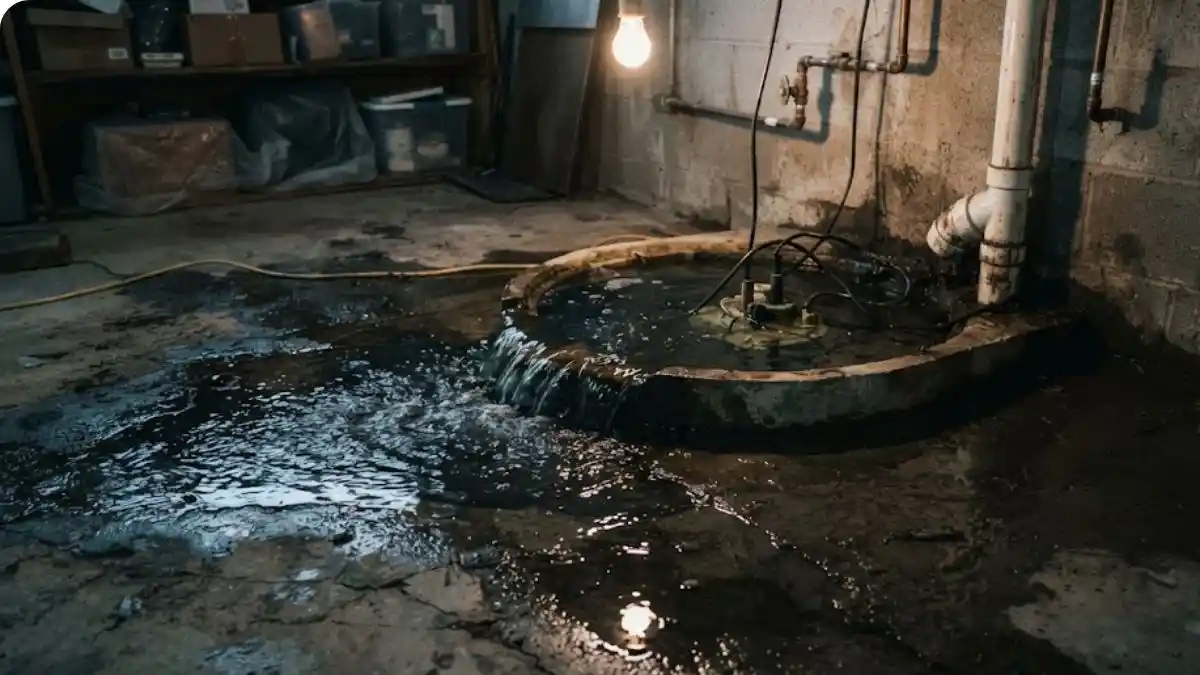
The call pattern repeats every summer: a heavy thunderstorm drops two inches of rain in 45 minutes, the power flickers, and by 2 AM the basement has four inches of standing water. Sump pump failure during Fairfax County's summer convective storms is one of the most common emergency calls we receive, and the geography of the county makes it especially prevalent in certain communities. Here is what to do when it happens to you.
Why Sump Pumps Fail During the Heaviest Events
The timing of sump pump failure is cruel: pumps are most likely to fail during the storms that need them most. Power outages during high-intensity storms disable primary pumps; battery backup systems extend the window but deplete under sustained high-volume input. Pumps that are undersized for the watershed above a particular basement may simply be overwhelmed by inflow that exceeds their rated capacity. Float mechanisms that have not been tested fail when the water rises faster than they've ever risen before.
Communities in lower-lying sections of Fairfax County — Burke, West Springfield, parts of Springfield, Kingstowne, Franconia, and areas along the Braddock Road and Route 50 corridors — are particularly vulnerable because they receive drainage from surrounding higher ground during heavy events, loading their sump systems with volume that they were not necessarily designed for.
Before You Call Anyone: Safety First
Do not enter a flooded basement until you confirm the electrical panel serving the space is off. Water and live electrical outlets in an enclosed space is a life-threatening combination, and the standing water in a flooded basement can conduct current from submerged outlets or appliances far from where you step in. If you cannot safely confirm the panel is off without entering the water, stay out and call your utility provider to shut off at the meter while you call for extraction help.
Once electrical safety is confirmed, limit your time in the water and wear waterproof boots if possible. The water may contain sewage from backed-up floor drains or contaminants from storage that was submerged.
What to Do While Waiting for the Crew
If you have a working wet/dry shop vacuum and the electrical safety question is resolved, you can begin surface extraction to slow the rate of water spread into wall cavities and under adjacent doors. However, consumer equipment does not substitute for truck-mounted extraction in a meaningful flooding event — a shop vac on a flooded basement is a delay measure, not a solution.
More useful in the waiting period: move anything that can be moved off the floor in adjacent utility areas, prop furniture on blocks to reduce contact with wet flooring, and photograph everything before any cleanup begins. The pre-extraction condition is your insurance baseline.
What Professional Flooded Basement Cleanup Involves
Our flooded basement cleanup crew arrives with truck-mounted extraction equipment sized for the volume of a residential basement flood. Carpet and pad are extracted and then removed — wet carpet pad is never salvageable and holds water against the subfloor, preventing drying regardless of how much drying equipment runs above it. After carpet removal, we assess subfloor moisture and position air movers to create targeted airflow across wet structural surfaces, combined with LGR dehumidifiers that pull moisture from the air as evaporation occurs.
If the basement is finished with drywall and insulation, the flood cut decision occurs next: removing the lower section of drywall to expose framing and insulation to airflow. Drywall sealed over saturated insulation in a wall cavity will develop mold within 48 hours regardless of surface dryness. The flood cut prevents this outcome. We document pre-demolition moisture readings for your insurance carrier.
The Role of Storm Flooding Insurance
Standard HO-3 policies cover sudden interior water damage from burst pipes and appliance failures, but exclude sump pump failure and groundwater flooding without specific endorsements. A sump pump rider or water backup endorsement covers the scenario described in this post when purchased before the event. Overland flooding from a storm that enters from outside — through the window well or the foundation gap — typically requires a separate NFIP flood policy.
Our storm flood response, professional water extraction, and appliance flood cleanup services cover both sump failure and overland flooding events with appropriate protocols for each water category. We document the source clearly for your insurance submission. For Fairfax County communities affected by summer storm flooding, call (703) 397-8315 immediately.