Published 2025-08-18 · Fairfax Fire & Water Specialists
Sewage backup is not comparable to clean water flooding. It is a biohazard event. The water that backs up into a Northern Virginia home through basement floor drains or below-grade toilets contains bacteria, viruses, and parasites that cause serious illness through skin contact and inhalation. The cleanup protocol that applies to a burst supply pipe — extract, dry, move on — does not apply to sewage. Every porous material that Category 3 water touched must come out.
Category 3 Water and Why It Changes Everything
The IICRC S500 standard classifies water intrusion by contamination level. Category 1 is clean water from supply lines and appliances. Category 2 is gray water from dishwashers, washing machines, and similar sources. Category 3 — called black water — is presumed to contain pathogens at concentrations that make contact dangerous.
The critical implication of Category 3 classification: porous materials cannot be dried in place. Drywall, carpet, pad, fiberglass insulation, and wood that has been submerged in Category 3 water must be removed and disposed of as contaminated material. Drying does not kill the pathogens; it desiccates material that still contains biological hazard. Mold will also colonize this material within 24 to 48 hours if left in place.
Why Sewage Backup Happens in Northern Virginia's Older Neighborhoods
The sewer laterals connecting homes in established Northern Virginia neighborhoods — Annandale, North Springfield, Falls Church, parts of Fairfax City and Burke — to the municipal main are often cast iron or clay pipe systems installed in the 1950s through 1970s. Over 50 to 60 years, root intrusion through joint gaps, sediment accumulation, and partial pipe collapse progressively restrict flow in these laterals. When the municipal system becomes pressurized during heavy rain events — as stormwater infiltrates through manhole covers and aging pipe joints — the backpressure pushes sewage backward through the restricted lateral into the lowest fixtures in connected homes.
Multiple homes on the same block may experience backup simultaneously during these events. This is not a coincidence; it reflects the shared lateral condition in the service area affected by the storm event.
Safety Before Anything Else
Do not enter a sewage-affected area without waterproof boots, nitrile gloves, eye protection, and a respirator. Sewage aerosols from disturbed backup water carry pathogens that infect through mucous membranes. Children and immunocompromised individuals should not enter the area under any circumstances. Keep the HVAC system off — return air vents near the floor can draw sewage-contaminated aerosols into the ductwork if the system is operating.
The Cleanup Scope for a Sewage Event
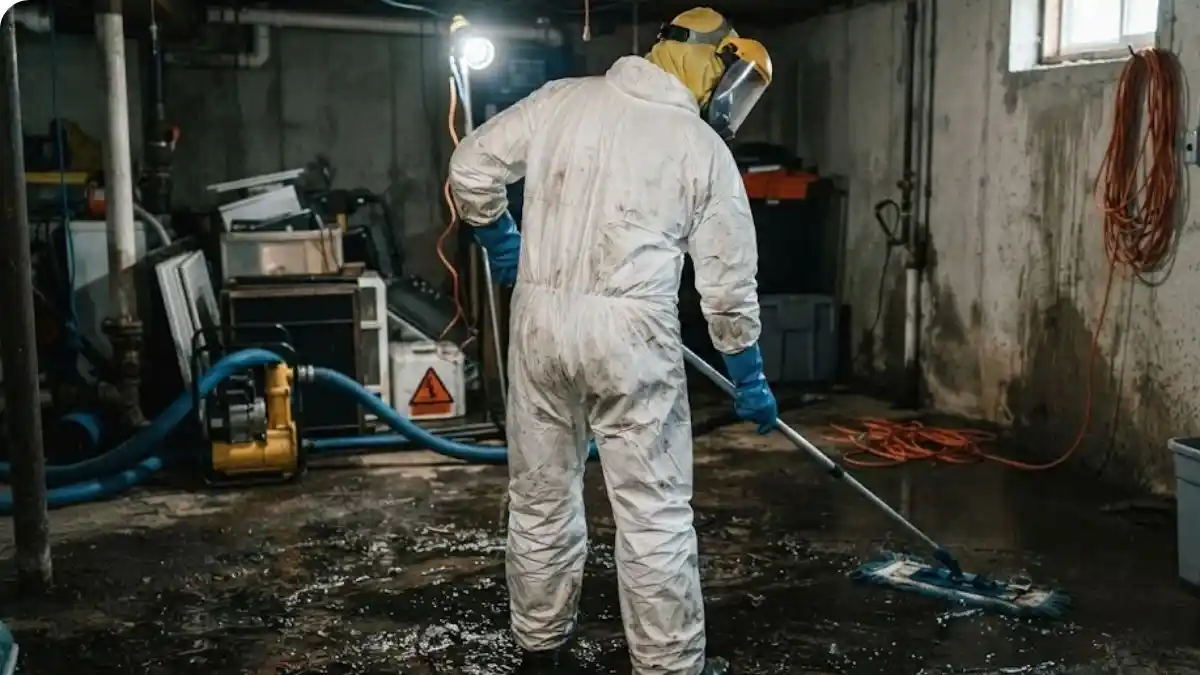
Our Category 3 black water remediation process uses Category 3 biohazard protocols throughout. All porous materials that contacted the water are removed: drywall, insulation, carpet, and pad. Hard non-porous surfaces — concrete, ceramic tile — are cleaned and disinfected with EPA-registered disinfectants. Wood framing with surface contact only is disinfected in place; wood that was submerged is assessed for structural integrity and replacement need.
After material removal and surface disinfection, structural drying equipment runs until framing and remaining structural materials reach IICRC drying standard readings. Mold risk is elevated in the post-sewage environment because of the organic material that accelerates colonization; we run drying equipment to completion and assess for mold growth at the end of the drying scope.
Insurance for Sewage Backup in Fairfax County
Standard HO-3 policies exclude sewage backup without a sewer backup rider. Given the sewer lateral condition in older Fairfax County neighborhoods, adding this endorsement before a backup event is the practical preparation step. If the backup originated from the municipal system during a storm event, there may also be a claim against the utility's liability depending on the circumstances; this is a separate matter from your HO claim and involves your jurisdiction's utility liability process.
We document sewage backup events clearly — source, entry points, affected area, materials removed — to support whatever claim path applies. For sewage backup cleanup in Annandale, Springfield, Falls Church, Fairfax City, and surrounding Northern Virginia communities, call (703) 397-8315.