Published 2025-08-05 · Fairfax Fire & Water Specialists
The 48-hour rule is not a metaphor or an approximation. Mold spores are present in ambient air in every building, and when structural materials remain above the moisture threshold that supports growth for more than 24 to 48 hours, colonization begins. In Fairfax County's humid summer climate, the window may be shorter. The difference between a basement flood that requires drying equipment and a basement flood that requires mold remediation is often a single day's delay in calling for help.
What Happens During the First 48 Hours
In the first hours after a basement floods, water wicks into drywall from the floor level, migrates through the floor assembly into the subfloor, and saturates fiberglass insulation inside wall bays. These materials do not dry on their own in a sealed basement environment — the ambient humidity is too high and air movement is too limited. They stay wet, and wet drywall paper and wood framing are the primary colonization substrate for mold spores already present in the air.
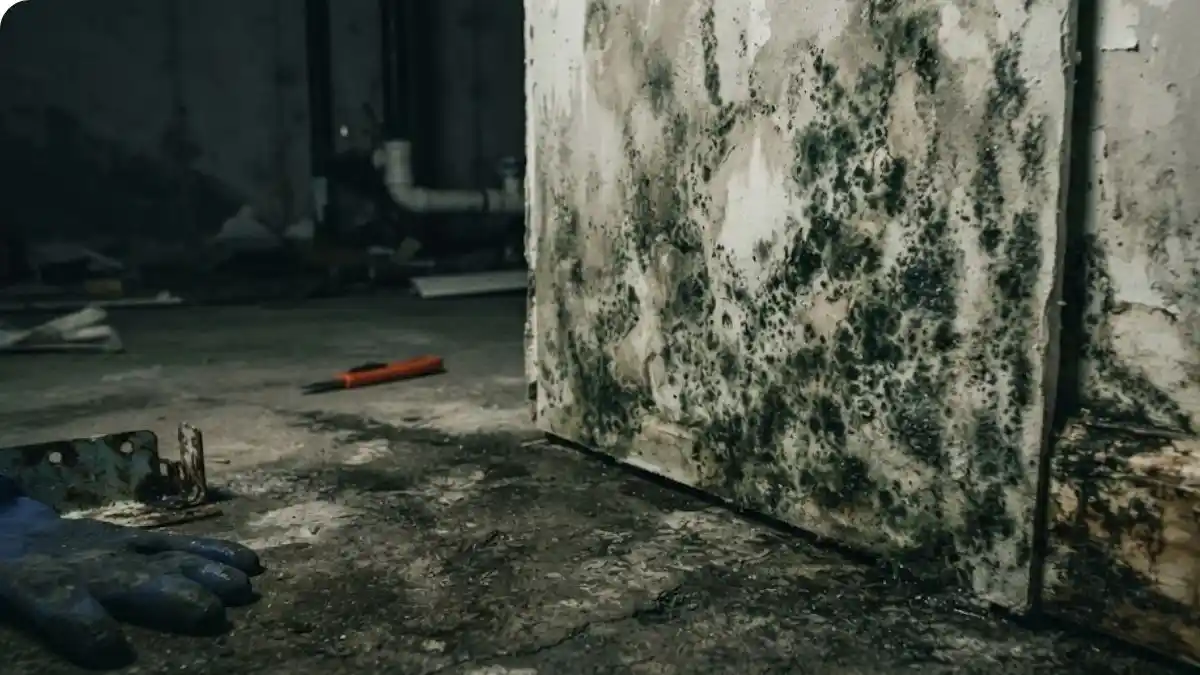
By 24 to 48 hours, visible mold growth is common on wet drywall paper and inside wet insulation. By 72 hours, the growth is typically established enough that remediation — removal of contaminated materials — is required rather than simply drying. The project has changed from water mitigation to water mitigation plus mold remediation, with the cost difference that implies.
Hidden Moisture Is the Problem
The moisture that drives mold in a flooded basement is often not the visible wet area. Water wicks up drywall from the floor level — typically 12 to 24 inches above the visible water line. Fiberglass insulation inside wall bays absorbs and holds moisture far longer than the drywall surface above it, and a moisture meter reading at the drywall surface can show dry while the insulation behind it remains saturated. This is the moisture that creates hidden mold behind apparently dry walls.
Our basement water extraction and drying process includes moisture mapping with calibrated meters at structural materials — not just visual assessment of wet areas. Where wall cavity moisture is elevated, the flood cut decision follows: removing the lower portion of drywall to expose the cavity, remove saturated insulation, and allow direct airflow to the framing. This is the intervention that prevents hidden mold, not the exception to the rule.
Fairfax County Summer Humidity Accelerates Mold
The 24 to 48 hour colonization window assumes average ambient conditions. Fairfax County's summer climate — with relative humidity regularly above 70% during June, July, and August — compresses this window. High ambient humidity reduces the evaporative gradient that would otherwise pull moisture from wet structural materials, keeping them wet longer. It also provides additional moisture that mold growth requires. A basement flood in August in Burke or Springfield or Annandale has a shorter effective drying window than the same event in November.
This is why summer basement floods in Fairfax County — which happen to coincide with the peak of summer convective storm season — have a particularly high rate of mold complications when professional drying is delayed.
What Mold Remediation Requires
When mold has established in basement wall cavities after a flood, drying alone cannot resolve it. Mold mycelium penetrates into the substrate material — drywall paper, wood grain — and cannot be killed in place by drying. The affected materials must be removed: drywall with mold growth is cut out, wet insulation is always removed, and wood framing with surface mold is cleaned and treated with antimicrobial agents per IICRC S520 protocols.
Our mold remediation service follows these protocols with containment, negative air pressure, and post-remediation verification. If you are not sure whether mold is present after a basement flood, our mold inspection and testing service provides the diagnostic assessment before remediation decisions are made.
The Preventive Investment
The cost difference between getting drying equipment in place within hours of a flood and getting it in place 48 hours later is often the difference between a drying project and a drying-plus-remediation project. For sewage backup events in basements, our sewage backup cleanup service applies Category 3 protocols that standard water mitigation does not. For homeowners in Springfield, West Springfield, Franconia, Kingstowne, and other Fairfax County communities with recurring basement flooding risk, having our number ready — (703) 397-8315 — before the next storm season is the practical preparation step.