Published 2025-06-03 · Fairfax Fire & Water Specialists
You turned the heat on at the start of the season. There was a sound — not quite an explosion, but something forceful — and now there is black soot on the walls, the ceilings, the furniture, inside the closets, and coming out of every vent register. That is a furnace puffback. It is one of the most disruptive non-fire events that can occur in a home, and it is more common in Fairfax County's older residential neighborhoods than most homeowners realize.
What Actually Happens During a Puffback
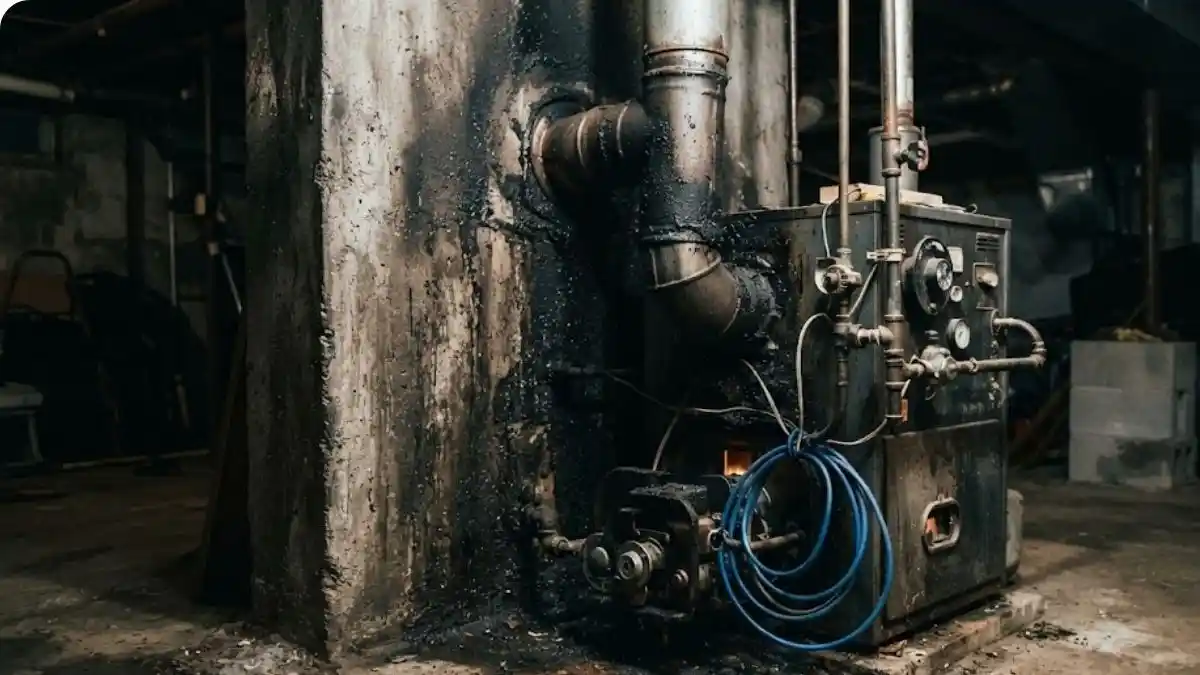
An oil-fired furnace burns fuel oil by spraying a fine mist through a nozzle and igniting it in the combustion chamber. When ignition does not occur immediately — because the nozzle is partially clogged, the igniter is inconsistent, or fuel has accumulated in the chamber during a period of non-use — excess fuel builds up. When ignition finally occurs, the accumulated fuel burns with more force than a normal cycle. The pressure pushes combustion byproducts backward through the exhaust system and into the ductwork. From there, the forced-air system distributes oily black soot to every room it serves.
The whole event takes seconds. The cleanup takes days.
Why This Happens More in Fairfax County's Older Neighborhoods
Fairfax County has a significant concentration of homes built between the mid-1950s and early 1980s that were originally heated with oil-fired systems. Many of these systems have been in place for 40 to 60 years. Original oil burner nozzles wear and develop inconsistent spray patterns. Igniters become less reliable. Extended periods without heating use — the summer months — allow residue to accumulate around the nozzle that disrupts the first burn of the heating season, which is when puffbacks most commonly occur.
Neighborhoods like Annandale, North Springfield, Cobbdale, Old Lee Hills, Ardmore, and Vienna have high concentrations of this housing era. If your home was built before 1980 and has an oil-fired furnace that has not been professionally serviced in recent years, puffback is a genuine risk when the first cold snap of the season arrives.
What Puffback Soot Does to a Home
Puffback soot is different from the soot produced by a structure fire. It is petroleum-based — derived from fuel oil — which makes it oily, greasy, and adhesive. It clings to painted surfaces, fabric fibers, and porous materials more aggressively than carbon soot from wood fires. Wiping it with a dry cloth does not remove it; it smears the oily residue across a larger area and can drive it deeper into porous surfaces permanently. Standard household cleaners do not lift it because they are formulated for water-soluble soils, not petroleum-based residue.
When puffback soot bleeds through paint that has been applied directly over it without a sealing primer coat, homeowners discover the problem months later as dark staining reappears through the new paint. This is preventable with the correct cleaning sequence and an encapsulating primer before refinishing.
The Correct Cleanup Sequence
Before any cleaning begins, the furnace must be shut off and the HVAC system disabled. Running the HVAC distributes soot continuously from inside the ducts until the system is stopped. The furnace must then be inspected and serviced by a qualified oil burner technician before it operates again — running it without service risks another puffback that recontaminates everything that has been cleaned.
Our dedicated furnace puffback cleanup service covers the full scope: HEPA vacuuming of loose soot from all surfaces, chemical degreasing of walls, ceilings, and hard surfaces with petroleum-appropriate agents, cleaning of contents including closet interiors and cabinet surfaces, and HVAC ductwork cleaning as the final step before the system is cleared for restart.
The ductwork cleaning at the end — not the beginning — is the correct sequence. Cleaning ducts first while rooms are still coated in soot means the duct cleaning tool travels through contaminated ductwork while airborne soot from rooms is still being disturbed.
Insurance Coverage for Puffback Events
Most standard HO-3 policies cover sudden and accidental soot damage from a puffback event under fire and smoke damage provisions. Coverage depends on the specific policy language and whether the event qualifies as sudden rather than the result of neglected maintenance. We document the scope and provide that documentation for your adjuster. Some insurers require a specific smoke damage rider; confirm with your carrier whether puffback events are explicitly covered or excluded under your policy.
For Fairfax County homeowners in Vienna, Oakton, West Springfield, Burke, and surrounding communities with oil-fired heating systems, call (703) 397-8315 for furnace puffback soot cleanup response.