Published 2025-05-10 · Fairfax Fire & Water Specialists
The hour immediately after a fire is extinguished is the highest-leverage window in the entire restoration process. The decisions made — and the mistakes avoided — in that hour directly determine how much additional damage accumulates before professional crews arrive, how well-documented the insurance claim is, and how quickly restoration can begin. Here is what Fairfax County homeowners should know before a fire ever happens.
Step One: Do Not Re-Enter Until Cleared
Fairfax County Fire and Rescue will clear the structure for re-entry when it is safe to do so. Before that clearance, the structure may have compromised load-bearing elements, active hot spots that can reignite, airborne toxins from burned synthetics, and carbon monoxide from smoldering materials. The instinct to go back in and assess damage or retrieve belongings is understandable, but re-entering before clearance is both physically dangerous and can complicate the insurance claim if you disturb the scene.
Once cleared for limited access, a simple N-95 respirator is the minimum respiratory protection before entering any fire-affected space. Burned synthetic materials including carpet, upholstery, and wiring insulation produce toxic particulate that lingers in the air long after visible smoke clears.
Step Two: Document Before Anything Is Touched
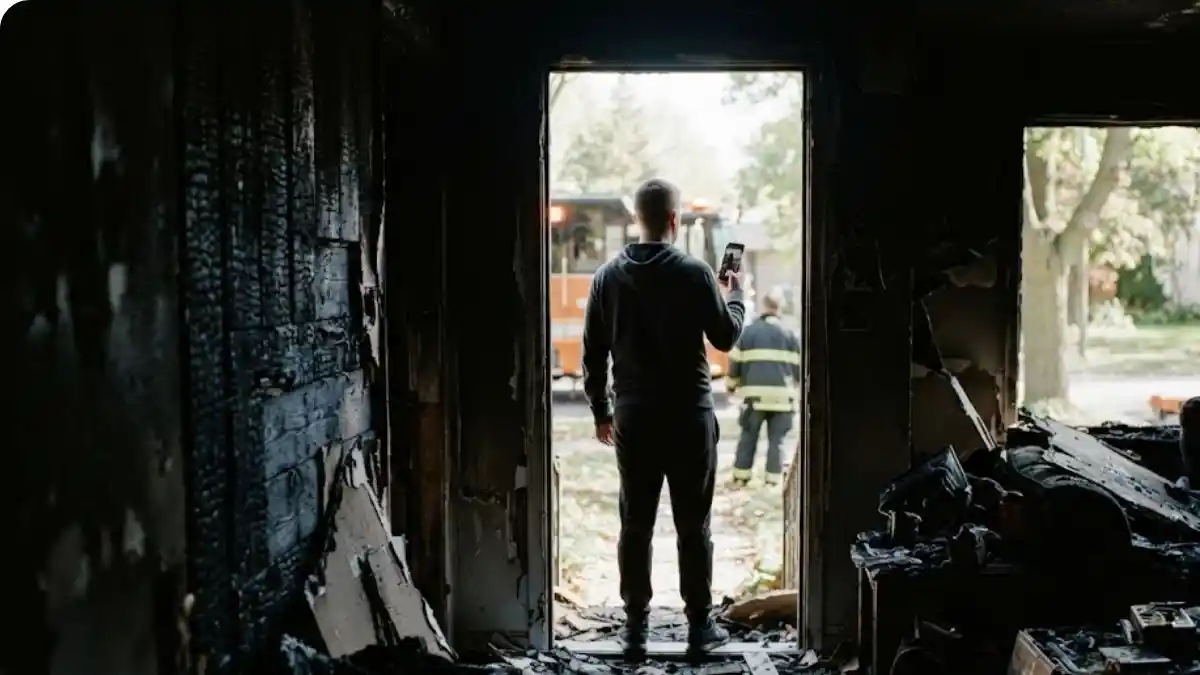
The most valuable thing you can do in the first hour is photograph every affected area before anything is cleaned, moved, or removed. Take wide-angle shots of each room, close-ups of obvious damage, and photographs of the fire origin location in situ. If the fire department cut a hole in the roof for ventilation, photograph it from outside. If they forced entry through a door, photograph the door condition.
This pre-mitigation documentation is the baseline your insurance adjuster uses to assess loss. Without it, the scope of damage before any cleanup occurred is harder to establish, particularly if materials must be removed quickly for safety reasons. Your phone camera is sufficient; the goal is coverage, not composition.
Step Three: Call for Emergency Board-Up
Any openings in the building envelope created by the fire — broken windows from heat, doors forced by firefighters, sections of damaged roof — must be secured before weather and unauthorized entry compound the fire damage. Rain entering through an open roof section saturates structural framing and creates mold conditions within 24 to 48 hours. A property with open windows is also a theft target in the hours after a fire when it is obvious something has happened.
Professional emergency board-up and roof tarping in Fairfax County can be coordinated while you are still on the phone with your insurance carrier. Board-up is a covered mitigation expense under most standard HO policies, and your insurer expects you to take reasonable steps to prevent further loss after a covered event. This is the step that fulfills that obligation.
Step Four: Notify Your Insurance Carrier
Call your carrier's claim line as soon as documentation is complete and board-up is arranged. You do not need to wait until the next business day; all major carriers have 24/7 claim intake lines. Have your policy number available and describe the event factually: what burned, when it was discovered, what the fire department found when they responded, and what immediate mitigation steps you have taken.
Do not give a recorded statement about the cause if you are uncertain — you can state what you observed without speculating about what caused the fire. Cause determination is part of the adjuster's process, not yours.
Step Five: Call a Restoration Company
Calling the carrier and calling a restoration company are not sequential — they can happen in parallel. The reason to contact a restoration crew promptly is that soot begins etching into metals and discoloring porous surfaces within hours. The cleaning window for salvaging materials shortens significantly over the first 24 to 48 hours. Smoke odor compounds penetrate porous materials during this period in a way that makes them progressively harder to remove.
Professional fire damage restoration begins with a documented assessment of the fire, smoke, and water damage scope. Our crew photographs conditions on arrival, records moisture readings for any firefighting water that must be dried, and develops a written scope that goes to your adjuster. You call one team for the board-up, the smoke cleanup, the water extraction from firefighting, and the odor treatment.
What to Avoid in the First Hour
A few things that instinct suggests but that make the situation worse: do not attempt to clean soot with a damp cloth (it smears oily soot deeper into surfaces and can permanently stain); do not run the HVAC system (it redistributes soot from the ducts throughout the home); do not throw away any items without documenting them photographically first (discarded items cannot be claimed as losses); and do not sign any contracts with restoration companies that show up unsolicited at a fire scene — this practice, called storm chasing, is common and not in your interest.
For homeowners in Annandale, Springfield, Burke, Vienna, McLean, and across Fairfax County, our crew is available at (703) 397-8315 around the clock to respond to fire events and begin the process from board-up through final clearance.