Published 2025-06-28 · Fairfax Fire & Water Specialists
The question every Fairfax County homeowner asks after a fire is: what is this going to cost? The honest answer is that the range is wide and the number depends almost entirely on scope — what burned, what smoke affected, how far the water from fire suppression spread, and how quickly the restoration process began. Understanding how fire restoration is actually priced helps you evaluate estimates and understand what your insurance claim should cover.
Why Cost Varies So Much
A kitchen fire contained to a stovetop that was caught early and extinguished with a fire extinguisher might involve smoke odor in adjacent rooms and protein smoke residue on nearby surfaces. The cleanup scope is measured in days and the cost may be in the low thousands. A structure fire that burned through a bedroom, produced smoke throughout the HVAC system, required firefighting water extraction in multiple rooms, and involves attic framing that absorbed heat transfer from a chimney fire produces a scope measured in weeks with a cost that can reach the mid-five figures or higher for mitigation alone, before reconstruction begins.
The factors that drive cost in either direction include how many rooms smoke reached, whether the HVAC system distributed soot to remote areas of the home, whether firefighting water requires extraction and structural drying, whether contents must be removed for off-site cleaning, how long between the fire event and the start of professional mitigation, and the construction type — older homes with original plaster walls and hardwood floors respond differently to smoke than modern drywall assemblies.
What the Mitigation Scope Includes
Professional fire damage restoration is priced by scope, not by the square footage of the home. The actual scope that drives cost includes emergency board-up and roof tarping if the structure has openings; water extraction and structural drying for firefighting water; smoke and soot cleaning on a surface-by-surface basis; HVAC inspection and duct cleaning; contents inventory and pack-out for off-site cleaning; and smoke odor treatment using thermal fogging, ozone, or hydroxyl generators.
Reconstruction — replacing drywall, refinishing floors, repainting — is a separate scope that follows completed mitigation. Mitigation and reconstruction are distinct billing phases that typically have different contractors. Our scope covers mitigation; reconstruction is coordinated with your insurance carrier's preferred contractor or your own.
General Ranges for Fairfax County Fire Restoration
These are illustrative ranges for planning purposes only — actual cost depends entirely on the specific scope in your home:
A small kitchen fire with smoke confined to the kitchen and limited HVAC spread: cleanup and odor treatment scope in the range of a few thousand dollars for mitigation. Reconstruction of any damaged cabinets or surfaces is separate.
A room-level fire with smoke throughout the HVAC system and firefighting water in two to three rooms: mitigation scope typically in the range of ten to twenty-five thousand dollars depending on scope specifics and materials involved.
A large-loss fire involving multiple rooms, structural involvement, and whole-home smoke contamination: mitigation scope that can extend well past twenty-five thousand dollars; reconstruction is a separate and often larger cost.
What Insurance Covers
Standard HO-3 policies cover sudden fire damage and the resulting smoke and firefighting water damage as a covered peril. The mitigation scope — all cleanup before reconstruction begins — is typically covered. Contents losses above your policy's contents limit and additional living expenses during displacement are separate coverage categories that your policy may include.
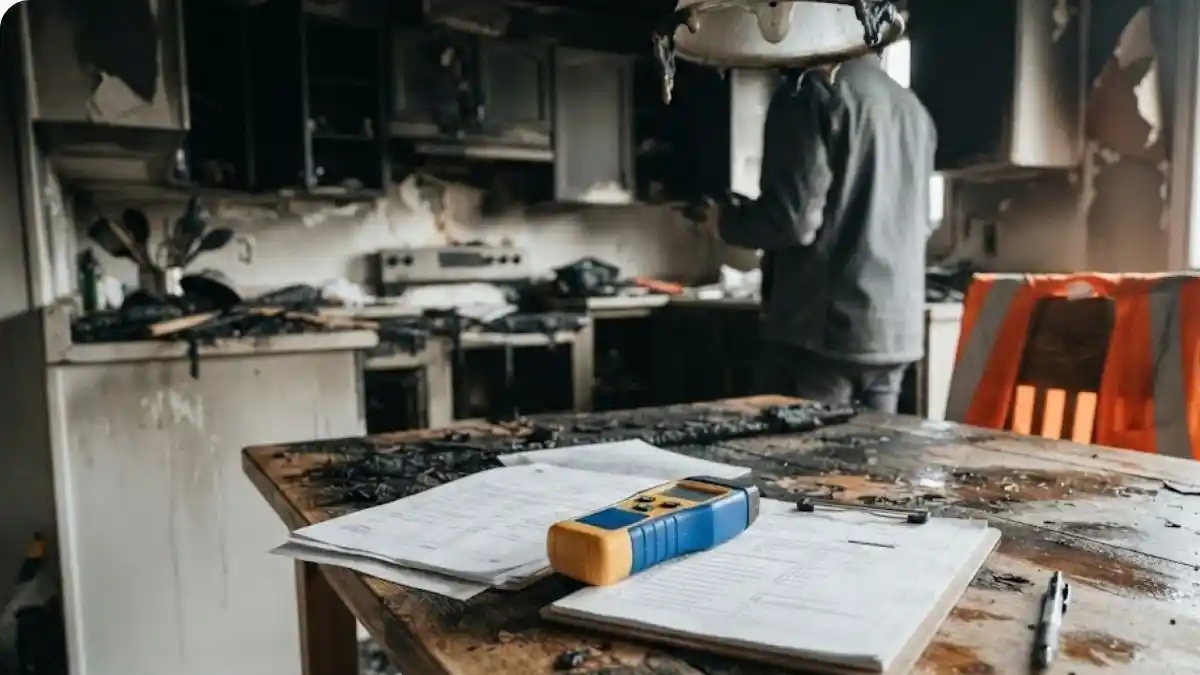
Our insurance documentation service provides scope documentation in adjuster-ready format: moisture readings at structural materials, photographs organized by room and damage type, and a written scope narrative that matches the format commercial adjusters use. We coordinate directly with your adjuster on technical questions about our methodology.
The Cost of Delay
The most direct cost driver within your control is how quickly professional mitigation begins. Soot etches metal surfaces within hours. Smoke odor compounds penetrate porous materials progressively over the first 48 hours. Firefighting water creates mold conditions within 24 to 48 hours if not extracted and dried. Every day between the fire event and the start of professional mitigation adds to the total scope. The cost of rapid response is always less than the cost of the additional damage that accumulates without it.
For fire damage restoration throughout Fairfax County — Springfield, Burke, McLean, Annandale, Vienna, and all surrounding communities — call (703) 397-8315 immediately after any fire event.